Syllabus Map
- Study map: Syllabus Study Map
Overview
- Pre-trained audio encoders map waveforms/spectrograms into transferable representations.
- They are often trained self-supervised on unlabeled audio, then fine-tuned for downstream tasks.
Pre-trained Audio Encoders
Common Input Representations
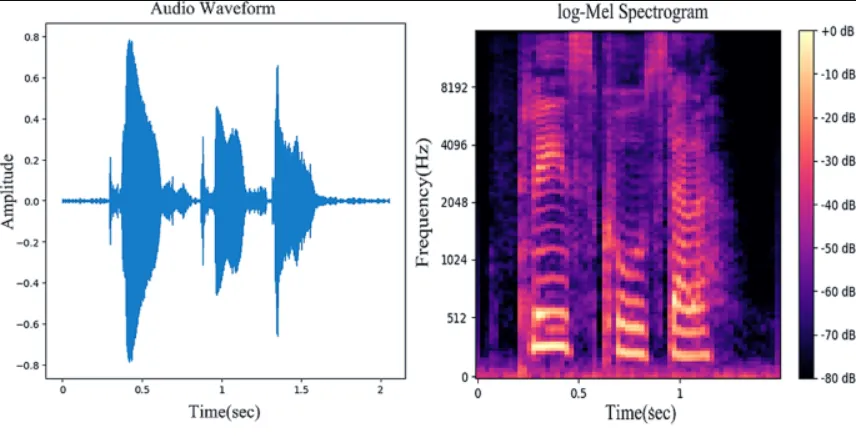
- Raw waveform (1D signal).
- Log-mel spectrogram (time-frequency 2D representation).
- Patchified spectrogram tokens (for transformer encoders).
Example Model Families
wav2vec 2.0
- Pretraining signal: masked prediction with contrastive learning on raw waveform latents.
- Strengths: strong speech representations with relatively simple downstream fine-tuning.
- Best for: ASR and speech tasks when unlabeled speech is available.
- Tradeoff: can be less robust than newer variants under heavy noise/channel shift.
HuBERT
- Pretraining signal: predicts pseudo-label clusters on masked frames (iterative target refinement).
- Strengths: stable training and strong phonetic/linguistic structure in embeddings.
- Best for: robust ASR transfer and speech representation learning.
- Tradeoff: quality depends on clustering/pseudo-label pipeline.
WavLM
- Pretraining signal: masked speech modeling plus denoising and speaker-aware objectives.
- Strengths: better robustness to noise and stronger speaker/discriminative cues.
- Best for: mixed speech tasks (ASR + speaker/event-style tasks).
- Tradeoff: more complex objective and training recipe.
Whisper Encoder
- Pretraining signal: supervised multilingual ASR/translation training inside encoder-decoder setup.
- Strengths: strong multilingual robustness and excellent real-world transcription behavior.
- Best for: end-to-end ASR pipelines and speech translation-style tasks.
- Tradeoff: less “pure SSL encoder” style; often heavier and tied to seq2seq decoding stack.
Self-Supervised Pretraining Idea
- Learn robust audio representations without manual labels.
- Mask portions of audio features and predict hidden targets.
- Objective details vary by model family.
Step-by-Step Usage
Step 1: Choose encoder by task
- Speech recognition: wav2vec 2.0 / HuBERT / Whisper-style encoders.
- Audio event classification: spectrogram transformer or CNN encoders.
Step 2: Prepare features
- Resample audio consistently (for example 16 kHz for speech).
- Normalize loudness and remove invalid/silent segments.
Step 3: Extract embeddings
- Run encoder to get frame-level or clip-level embeddings.
- Pool over time for utterance-level tasks.
Step 4: Train downstream head
- Classification head for event/intent.
- CTC or seq2seq decoder for transcription tasks.
Step 5: Fine-tune selectively
- Start with frozen encoder.
- Unfreeze upper layers if domain mismatch is large.
Evaluation
- ASR: WER/CER.
- Classification: accuracy, macro-F1.
- Retrieval/speaker: Recall@K, EER, minDCF.
Practical Notes
Data and Domain
- Pretraining data diversity strongly affects robustness (accents, noise, microphones).
- Domain adaptation with continued pretraining can improve noisy or specialized audio.
Serving Constraints
- For long audio, chunking + overlap or streaming encoders are important for latency.