SMU H3 Map
- Content map: SMU H3 Game Theory Map
Games of Incomplete Information
Nature
- Nature (chance) selects the ingredients of the game at random
- Players have common knowledge of the structure
- It becomes a game of imperfect information where players may know some of nature’s moves
- Nature has no stake in the game, so random choices are made in a non-strategic manner
Strategies
- Strategies will depend on the information about nature’s moves an choices available to players
- Equilibrium concept stays the same but players will have to form beliefs about the other players’ informatino in oder to find the best plan of action
- These beliefs must be consistent with those players’ choices (whenever possible)
Trade Wallet Game
Rules
- Nature draws and (wallets for P1 and P2 respectively)
- This is done independently from the set with equal probability such that
- P1 knows , P2 knows , and both players know about the wy nature moves
Strategies
- Strategies are the rules that maps the (keep, swap) decision for any possible amount in one’s wallet
- There are strategies
- The equilibrium is the pair of strategies that are the mutual best responses
Iterative Deletion
For
- If the player keeps, he receives
- If the player swaps, he receives
- Strategies where player swaps are weakly dominated by strategies by player keeps where
For
- If the player keeps, he receives
- If the player swaps, he receives
- Strategies where player swaps are weakly dominated by strategies by player keeps where
For
- If the player keeps, he receive
- If the player swaps, he receives
Equilibrium #1
-
Let the strategies be defined as follows
- : Swap when = 5, keep otherwise
- : Keep always
-
is an equilibrium
-
Suppose P2 adopts , what is the expected payoff for P1 if he adopts ?
| Choice | Outcome | |
|---|---|---|
| 5 | SWAP | Trade if , No Trade if |
| 6 | KEEP | No Trade |
| 7 | KEEP | No Trade |
| … | … | … |
| 55 | KEEP | No Trade |
- P1 with has the same payoff from and , meaning no gain from deviating
- When under , there are two possible outcomes
- , then the trade results in
- , then the trade results
Homework
- Verify that the following strategies are equilibria:
Behaviour Reveals Information
- Suppose P2 adopts the following strategy
-
is the cutoff, where
-
P1’s best response is as follows if P1 chooses SWAP
| Outcome | Payoff | Probability | |
|---|---|---|---|
| 5 | Trade | 5 | |
| 6 | Trade | 6 | |
| … | … | ||
| 26 | Trade | 26 | |
| 27 | No Trade | ||
| 28 | No Trade | ||
| … | … | ||
| 55 | No Trade |
- Expected payoff if P1 chooses swap with
- Expected payoff if P1 chooses keep with
- Thus, P1 chooses keep is better whenever
-
This reveals that , since it is expected that
-
Thus, P1’s best response is
- is the cutoff, where
Equilbrium #2
- An equilibrium, therefore, will be in cutoff rules
-
In an equilibrium,
- is BR to
- is BR to
-
The best cutoffs are thus
- (1) :
- (2) :
-
(1) and (2) must hold simultaneously
-
Thus, the equilibrium strategy is to not swap
Types of Signalling Equilibria
Pooling Equilibrium
- Action: All Sender types choose the same action.
- Information: The Receiver gains no new information; the signal is “noise.”
- Requirement: Rewards for mimicking are high, or the signal cost is too low to be restrictive.
- Result: The Receiver must rely on prior beliefs to make a decision.
- Example: If a certification is granted without a rigorous audit, both safe and dangerous firms will display it.
Separating Equilibrium
- Action: Different Sender types choose distinct, different actions.
- Information: The Receiver gains perfect information; the signal acts as a clear “label.”
- Requirement: Signal cost is high enough to deter low-quality types ().
- Result: The Receiver becomes certain of the Sender’s true identity or quality.
- Example: Only high-ability students can finish a grueling PhD; the degree perfectly signals ability to employers.
Semi-Separating (Hybrid) Equilibrium
- Action: One type always signals; the other type randomises (bluffs) their move.
- Information: The Receiver gains partial information; they update their probability but remain uncertain.
- Requirement: Payoffs make the low-type indifferent between mimicking the high-type or revealing themselves.
- Result: A state of refined guessing where the signal makes a specific type more likely but not guaranteed.
- Example: A poker player with a weak hand bluffs only occasionally to keep the opponent from knowing if a bet indicates strength.
Signalling Games
Setup
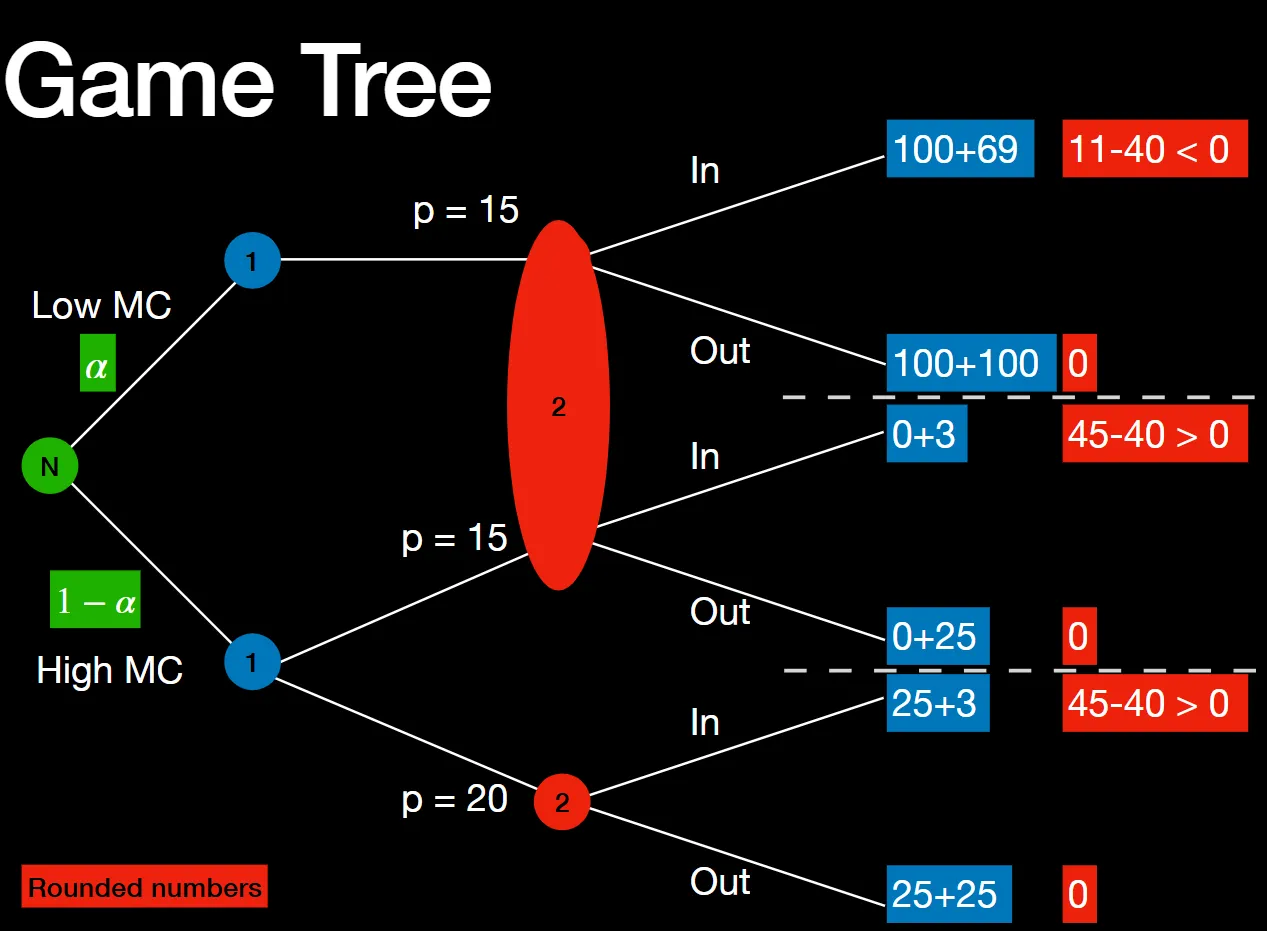
- Incumbent firms can have
- with probability
- with probability
- Entrant firms have and
- Demand curve is
Stages
- Stage 1: Incumbent sets the monopolist price of each type
- Stage 2: Entrant decides whether to enter upon observing the price charged by the incumbent
- If the entry occurs, the two firms play a quantity duopoly game
Game Tree 1
Separating Equilibrium
Definition
- In a separating equilibrium, the Incumbent fully reveals the based on their action
Strategy
- This is achieved via the strategy
- Given the strategy, the Entrant understands that 15 can only come from a low Incumbent and 20 can only come from a high Incumbent
- The Incumbent has low if the price is 15 and has high if the price is 20
- Therefore, the Entrant optimally chooses given his (rational) beliefs about the Incumbent types
Alternative
- The only other strategy is so that the Entrant always stays out
- However the high Incumbent earns lower profits by letting the Entrant out at a price of 15
- There are no profitable deviations and the proposed strategies and beliefs constitute a Separating Equilibrium
Pooling Equilibrium
Definition
- In a pooling equilibrium, the Incumbent adopts the same pricing regardless of the
Strategy
- The Incumbent firm adopts the pricing
- Given this strategy the Entrant cannot improve on his prior knowledge about types
- The probability of a low Incumbent remains at
Analysis
- If the Incumbent firm has a high ,
- Choosing will result in a payoff of 3 or 25
- Choosing will result in a payoff of 28 or 50
- is dominated by
- There is no pooling equilibrium
Game Tree 2
Separating Equilibrium
Strategy
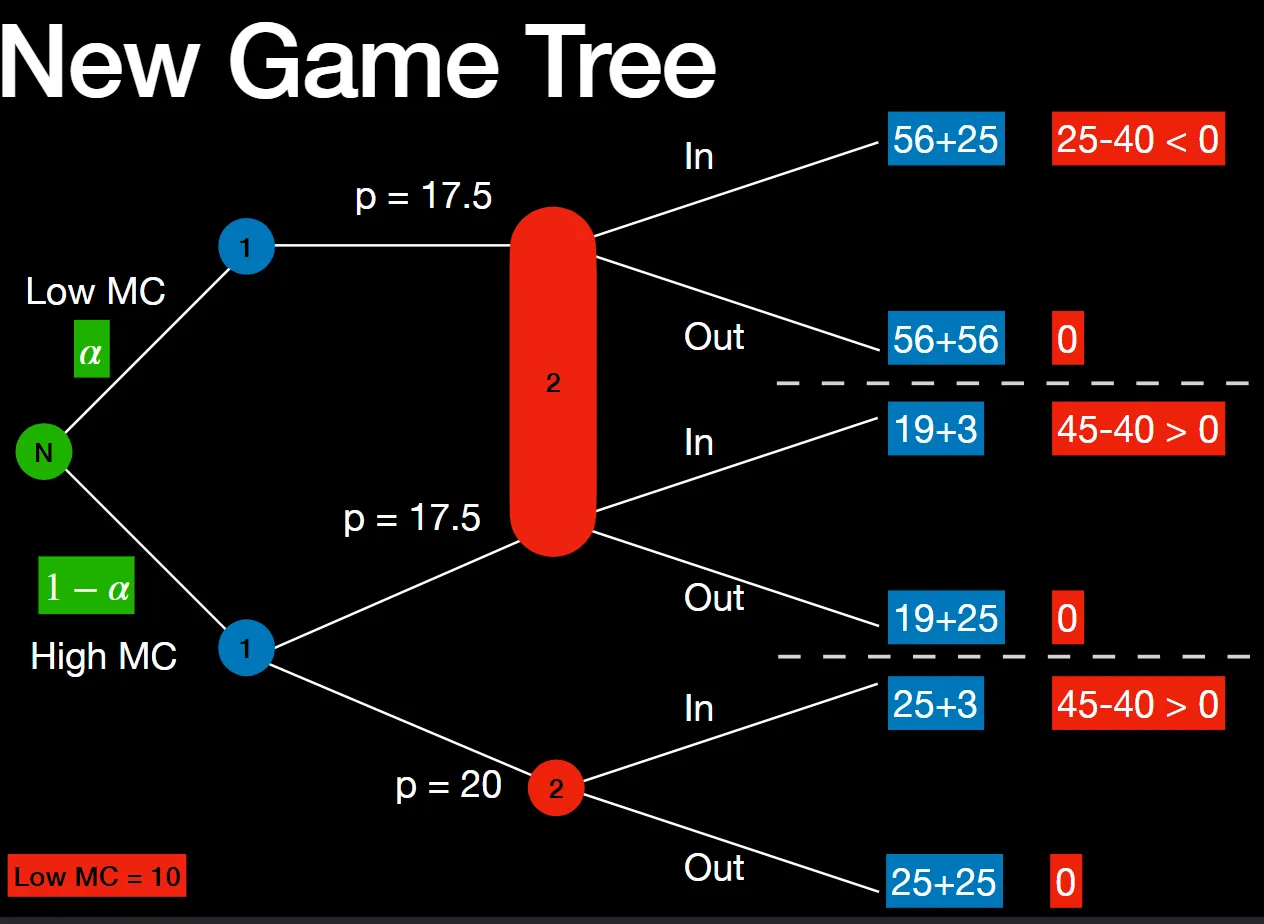
- There is no separating equilibrium
- There is an incentive to deviate from even when the Incumbent has high
Pooling Equilibrium
Strategy
- There is a pooling equilibrium
- There is no incentive to deviate from
Analysis
-
P1 chooses when high and when low
-
P2’s strategy is a choice:
- (In or Out) if
- (In or Out) if
-
Since P1 is coosing
Set 1
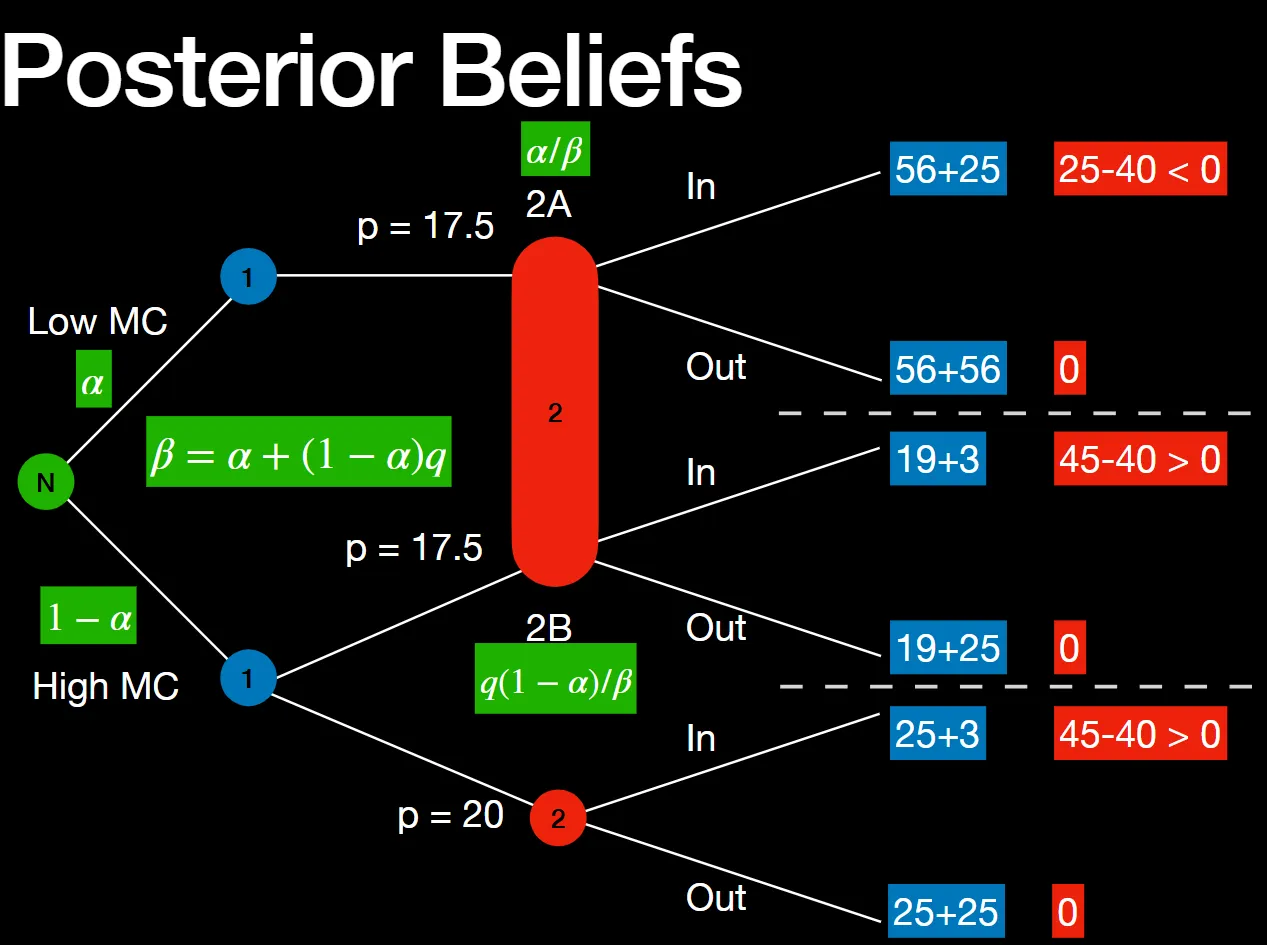
- P2 cannot use the information from that strategy to form beliefs about P1’s type if is observed
- The game tree however suggests that only P1 and high can choose
- Hence, the following probabilities are true:
- P2’s best response to is In
Set 2
-
If is observed, P2 does not learn anything that P2 already knew
-
This is equivalent knowledge to
-
By choosing In
- However, the pooling equilibrium can only exist if the best response for P2 is Out
- We need the opposite inequality to hold
Conclusion
- and
Semi-Separating Equilibrium
Strategy
-
For P1
- P1 (low ) chooses with probability
- P1 (high ) chooses with probability
-
For Nature
- Nature chooses P1 (low ) with probability
- Nature chooses P1 (high ) with probability
-
Thus,
- is favourable case if I ask what is
- is favourable case if I ask what is