SMU H3 Map
- Content map: SMU H3 Game Theory Map
Tit-for-Tat for the Infinite Game
Definition
- Strategy copies the behaviour from for the game at timestep
- 4 classes of subgames matter
Payoffs
Subgame 1
Subgame 2
Subgame 3
Subgame 4
Answer
Subgame 1
- We are in the subgame after observing
- if no deviation
- if deviation
- To deviate, we need
Subgame 2
Subgame 3
Subgame 4
- if no deviation
- if deviation
- To deviate, we need
Carrot Game
Rules
- Two players with one box each
- One player looks into the box to see if he has a carrot or not
- The other player has to decide whether to swap boxes or keep the box that he was given
- The objective of the game is to receive the carrot
- There is imperfect information since only one player knows where the winning condition is
External Uncertainty
Definition
- Random events that are beyond the control of the single decision maker
- Who then takes them as given and acts in order to maximise his or her expected payoff
- Agents may not like taking risk (risk aversion) and so they look for solutions to protect themselves against it
Risk Sharing
- If things go well for me, they go bad for you and vice versa
Agreement 1
| Outcome | Good | Bad |
|---|---|---|
| Results | 160,000 | 40,000 |
| Probability | 0.5 | 0.5 |
Agreement 2
- If an agreement is made such that the lucky one pays 60000 to the unlucky one
| Outcome | Good | Bad |
|---|---|---|
| Results | 100,000 | 100,000 |
| Probability | 0.5 | 0.5 |
- Risk sharing occurs when you have a definite outcome of the expected payoff on average without incurring risk
Risk-Aversion
- A risk-averse agent minimises uncertainty even when the expected payoff is the same
Formalising Risk-Aversion
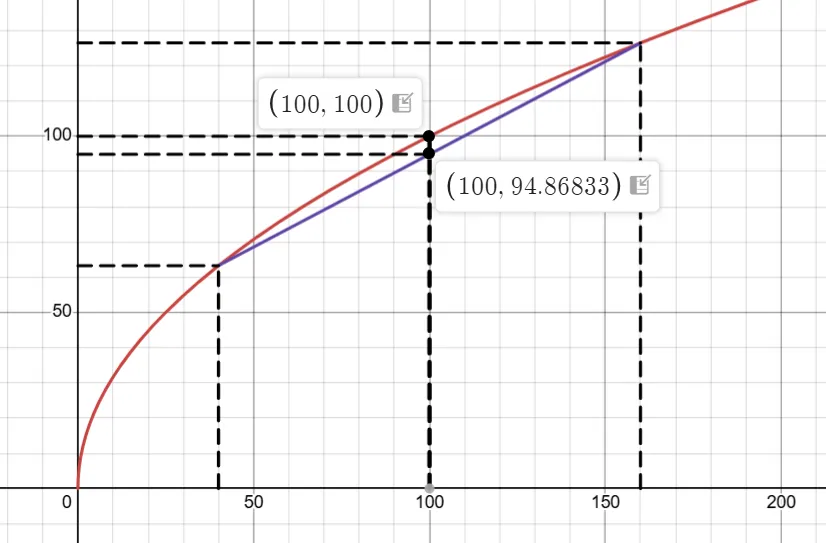
- Suppose that we value the amount of at
- Expected payoff from being payoff-dominant is
- Expected payoff from the risk-dominant agreement is
Insurance
Definition
- Insurance companies take some risk in exchange of cash
- Going back to the example, if I had 90,000 in each state, I would be getting the same expected payoff of 300
- Since by being subject to risk, on average I have 100,000
- I can conclude that 10,000 is the maximum price I am willing to pay (to the insurance company) to forgo risk
Strategic Information Transmission
Definition
- The extent to which the informed party wants to reveal the information is a matter of strategic considerations
- The informed party should decide to reveal what is in his best interest to reveal
- The uninformed party is aware of this fact
Cheap Talk
Definition
- The easiest way to transmit information is by communicating it
- When this does not cost anything to the player, we say we are in the context of Cheap Talk games
- Cheap Talk games add one round of pre-play communication to the game
Insights
- If the interests in the game are aligned, pre-play communication may help solving coordination problems
- However there are other sub-game perfect equilibria in which the pre-play communication is ignored (babbling equilibria)
Rules
- Player 1 announces his choice
- Both players maker their choices after the announcement
- Cheap Talk works in this case:
- Player 1 says “Local Latte” and then chooses to do whatever he has said at the pre-play communication
- Player 2 chooses to go wherever Player 1 said he was going
- Cheap Talk does not work in this case:
- Player 1 says “Local Latte” and then chooses Starbucks no matter his announcement
- Player 2 chooses Starbucks no matter what Player 1 has said
| Starbucks | Local Latte | |
|---|---|---|
| Starbucks | ||
| Local Latte |
Zero-Sum Games
- Cheap Talk does not work in zero sum games
- In other words, when the interests between the two players are in total conflict, cheap talk does not work
Lemon Market
Example 1
-
If the value of a used car can be either or
- If the seller offers , buy since the expected payoff is
- If the seller offers , do not buy since the seller will sell the car worth , meaning that the expected payoff is
-
The seller who knows the value of the used car accepts an offer to buy that car at the average price
Example 2
- Suppose the value of the car is for the seller
- Suppose the buyer is willing to pay for the car (but he does not know )
Illustration
- When you pay , the average value of the car is
- To the buyer, the value of the car is
- You lose on average, since
Signalling
- Informed parties can credibly convey information to the uninformed party if this is convenient to them
- Signalling is a strategy used to resolve asymmetric information, where one player has information that the other player lacks
Education Game
Setup
- Student and Student
- They take courses at school:
- Type can take hard courses at \ 3000 $
- Type can take hard courses at \ 14000 $
- Employers value workers
- Type at \ 160000 $
- Type at \ 60000 $
Signalling Function
- Type may find it worthwhile signalling their type by taking enough hard courses that type students do not want to take
- The signal works if it cannot be faked, that is:
- Type students prefer to take hard courses (rather than deviating to choose courses)
- Type students prefer to take hard courses (rather than deviating to choose courses)
Incentive Compatibility
- must satisfy the following inequalities
- Upper bound
- Lower bound
- This means that there is no gains from deviating in strategy, meaning that the student is indifferent
Individual / Participation Rationality
-
Suppose type students can secure at least \125,000 $
-
Suppose type students can secure at least \30,000 $
-
Type is always incentivised to participate ( \ 60000 > $30000 $)
-
Type is only incentivised to signal such that
- Thus,
Pooling Equilibrium
- A separation may not be the only possible outcome
- Pooling of types may occur as well, in which case both and students earn the same wage, and none of them take hard course while in college
- The common wage is the expected value from hiring an A or a C student, that is
- While a student prefers pooling from separation, an student does not
- So this type may have an incentive to deviate and take just one hard course
- We need that employers understand that the deviation comes from the student
- Thus, deviations are not profitable and pooling equilibrium occurs when
- We need large enough for pooling equilibrium to arise in this context