b is for the player that chooses brunette when the blonde is not matched with anyone
c is for the player that chooses brunette when the blonde is matched
d is for the player when there are at least 2 players choosing blonde
Nash Equilibria (Pure Strategy)
(blonde,brunette,brunette,brunette)
No player can choose another option which have a better payoff
No other player can choose blonde since everyone would get a payoff of d
The payoff is (a,c,c,c)
This applies for all permutations of n
Nash Equilibria (Mixed Strategy)
let a=3,b=2,c=1,d=0
let p denote the probability that a player chooses blondelet 1−p denote the probability that a player chooses brunette
We want to find a symmetric mixed strategy Nash equilibrium where all players adopt the same randomisation (p,1−p)
From the point of view of P1
For Blondes
(π1)blonde{30 if nobody chooses blonde if one or more chooses blondeP(no blonde)=(1−p)n−1P(at least one blonde)=1−P(no blonde)E(π1)blonde=3⋅(1−p)n−1+0⋅(1−(1−p)n−1)E(π1)blonde=3(1−p)n−1
For Brunettes
(π1)brunette{12 if one chooses blonde if nobody or more than 1 choose blondeP(one chooses blonde)=p(n−1)(1−p)n−2P(nobody or more than one blonde)=1−P(one chooses blonde)E(π1)brunette=1⋅p(n−1)(1−p)n−2+2⋅(1−p(n−1)(1−p)n−2)E(π1)brunette=2−p(n−1)(1−p)n−2
Mixed Strategy Equilibrium
For the mixed strategy equilibrium to exist, we apply product rule
let f(p)=(1−p)n−2(3+p(n−4))f(0)=(1−0)n−2(3+0(n−4))=3f(1)=(1−1)n−2(3+1(n−4))=0thus, there lies a solution where f(p)=2for n≥2,n∈R
Probability
Definition
Probability measures the likelihood that an event or set of events occur(s)
This can also be represented as the frequency by which such an event has occurred over a large number of observations
Example
Consider an experiment that generates the outcomes x1,x2,...,xn
Each of the outcomes have the associated probabilities p1,p2,...,pn
Where:
0≤pi≤1s.t. i∈{1,2,...,n}
∑i=1npi=1
We define the expected payoff (or weighted average) of the experiment is defined as:
E(x)=i=1∑npixi=p1x1+p2x2+...+pnxn
We allow the players to choose at random (commit to a random device)
Each player wants to find maxE(x) for themselves
Law of Large Numbers
The Law of Large Numbers states that as the number of independent, identical trials increases, the sample average of results converges closer to the expected theoretical mean.
Rules
We will make extensive usage of the rules in probabiility theory
Product Rule
Definition
P(A)=i=1∏kAi=A1⋅A2⋅...⋅Ak
Divide a set of events A into finite subsets A1,A2,A3,...,Ak
Given that each subset of event is independent from one another
The probability of the set of events is the product of the probability of its constituent events
Example
For a coin with two sides (heads vs. tails)
The probability of any possible outcome after flipping the coin three times A is given by:
P(A)=21⋅21⋅21=81
Thus, this produces 8 possible outcomes, which can be represented in the form of
total no. of outcomesno. times A occurs
Summation Rule
Definition
If an event can happen through several mutually exclusive cases, its total probability is the sum of the probabilities of those cases.
For mutually exclusive events A1,A2,...,Ak:
P(A1∪A2∪...∪Ak)=P(A1)+P(A2)+...+P(Ak)
Example
Suppose I roll a dice twice, keeping track of the dots at the top of the dice
What is the probability that I obtain a sum of 5 across both rolls
Roll 1
Roll 2
Probability
1
4
612=361
2
3
612=361
3
2
612=361
4
1
612=361
The total probability of obtaining a sum of 5 is
P(sum=5)=361+361+361+361=364=91
Conditional Probability
Given two events A and B, the probability that A happens given B is given by:
P(A∣B)=P(B)P(A∩B),P(B)>0
Types of Strategies
Pure Strategies
Choosing one specific action with probability 1
There is no randomisation: the same action is played whenever that information set is reached
In matrix games, a pure strategy corresponds to selecting one row (for Player 1) or one column (for Player 2)
Mixed Strategies
A probability distribution over pure strategies
The player randomises between actions (for example, choose action A with probability p and action B with probability 1−p)
Mixed strategies are often used when no stable pure-strategy best response exists
Degenerate vs Non-degenerate Probability Distributions
A degenerate distribution puts probability 1 on a single action and 0 on all others
A non-degenerate distribution puts positive probability on at least two actions
A pure strategy can be viewed as a degenerate mixed strategy
Difference Between Pure and Mixed Strategies
Randomisation: pure strategies use no randomisation; mixed strategies require randomisation
Representation: pure strategies are single actions; mixed strategies are probability distributions over actions
Use case: pure strategies are enough when a stable deterministic choice exists; mixed strategies are useful to keep opponents indifferent and prevent being predictable
Nash Equilibria for Pure and Mixed Strategies
The definition of Nash equilibria does not change
With mixed strategies, 2 properties arise:
1. In a mixed strategy equilibrium, the player must be indifferent between all the pure strategies in the mixing bunch
2. In a mixed strategy equilibrium, the pure strategy that is not in the mixing bunch cannot give a better expected payoff
Why have mixed strategies?
Sometimes players want to be unpredictable, so opponents cannot exploit a fixed pattern.
In some games, there is no pure-strategy Nash equilibrium; allowing randomisation gives an equilibrium in mixed strategies.
Mixing can make the opponent indifferent between their actions, which is a key condition in mixed-strategy equilibrium.
Real-world interpretation: players can use a random device (coin flip, dice, algorithm) to commit to probabilities.
Chicken Game
Game 1
Setup
Options: Go straight or swerve
Let P(straight)=p denote the probability of going straight and P(swerve)=1−p
The mixed strategy Nash equilibrium is {(21,21),(21,21)}
Game 2
Setup
Options: Go straight or swerve
Let P(straight)=p denote the probability of going straight and P(swerve)=1−p
Mixed strategy can be (p,1−p)
Pure strategies are (0,1) and (1,0)
P2 \ P1
Swerve
Straight
Swerve
1, 1
0, 2
Straight
2, 0
-1, -1
For P1, P(straight)=r and P(swerve)=1−r
For P2, P(straight)=p and P(swerve)=1−p
Best Response Analysis
Payoffs of P1
Outcomes
Payoffs
-1
p⋅r
2
p⋅(1−r)
1
(1−p)⋅r
0
(1−p)⋅(1−r)
E(π1)=p[−r+2(1−r)]+(1−p)[r+0(1−r)]E(π1)=p⋅E(π1)straight+(1−p)⋅E(π1)swerve∴E(π1)=E(π1)swerve+p[E(π1)straight−E(π1)swerve]let Δ1=E(π1)straight−E(π1)swerve:⎩⎨⎧E(π1) is straight line with positive slopeE(π1) is straight line with negative slopeE(π1) is straight horizontal lineif Δ1>0if Δ1<0if Δ1=0Δ1=2−3r−r=2−4rr=21BR1(r)=⎩⎨⎧10[0,1]if r<21if r>21if r=21
Homework
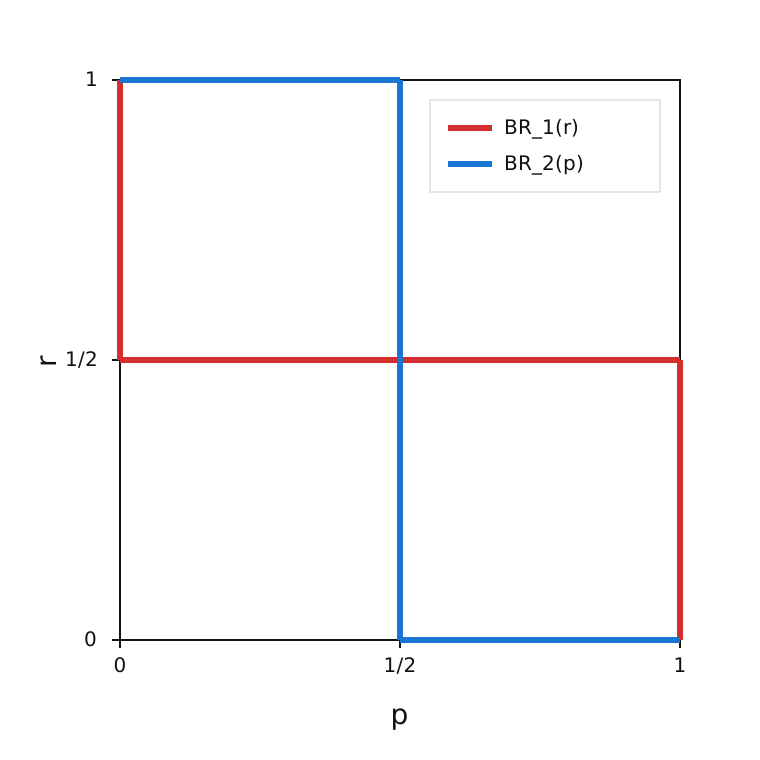
BR2(p)=⎩⎨⎧10[0,1]if p<21if p>21if p=21
Find BR2(p) for P2 using the steps from before
Graph
You identify three Nash equilibrium points:
({1,0},{0,1}) -> (Straight, Swerve)
({0,1},{1,0}) -> (Swerve, Straight)
({21,21},{21,21})
Game 3
Setup
2 Players
3 Strategies
Fully mixed Nash equilibrium -> All options are in the mixing the mixing bunch
Partially mixed Nash equilibrium -> 2 or 3 strategies are in the mixing bunch
Payoff matrix
P2 \ P1
A
B
C
A
1, 1
1, 0
0, 0
B
0, 1
2, 2
1, 0
C
0, 0
0, 1
3, 3
Pure Strategy Nash Equilibra
It is obvious, the Pure Strategy Nash Equilibra are: