SMU H3 Map
- Content map: SMU H3 Game Theory Map
Sub-Games and Sub-Game Perfect Equilibria
Definition of Sub-Game
- Part of the game tree that starts at a single node and that can be considered as a Game in isolation
- This means that it can be computed separately using backward induction
- This helps calculating the Nash equilibrium when the game reaches the state of a sub-game
- The individual decision problem can be replaced with the Nash equilibrium outcome, as it is anticipated that the players will play rationally
Definition of Sub-Game Perfect Equilibrium
- Replaces the rollback equilibrium
- A pair of strategies, one per player, that constitute an equilibrium in all sub-games
- This means every set of strategies which results in a Nash equilibrium in every subgame
- This can be found using backward induction
Entry and Pricing Game
Setup
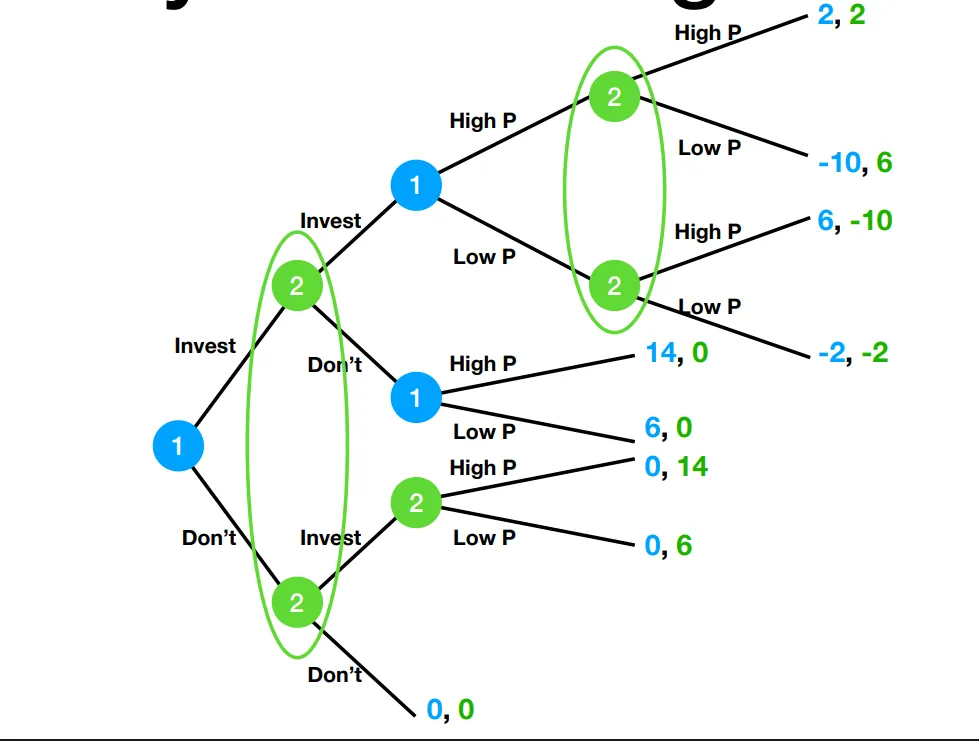
- When a circle is made around two choices, it means the player is unaware of the decisions made by the other player
- This allows simultaneous games to be mapped out as game trees
Identifying Sub-games
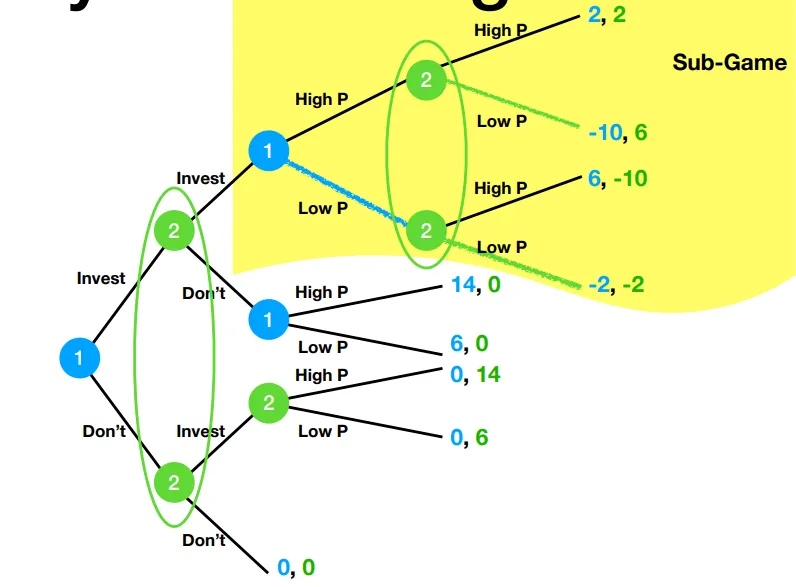
- Sub-games can be obtained when games are broken down into their component branches
- This simplifies the games as each game can be considered as being isolated
- In this game, there are 4 subgames:
- Subgame 1:
- Subgame 2:
- Subgame 3:
Breaking down subgames
Subgame 1
| P2 \ P1 | High P | Low P |
|---|---|---|
| High P | 2, 2 | -10, 6 |
| Low P | 6, -10 | -2, -2 |
- For P1, the option of High P is dominated by Low P
- For P2, the option of High P is dominated by Low P
- There is a weakly dominant strategy of Low P for both players, even if the Pareto efficient strategy is High P
Subgame 2
| P2 \ P1 | High P | Low P |
|---|---|---|
| High P | 2, 2 | -10, 6 |
| Low P | 6, -10 | -2, -2 |
- For P1, the option of High P is dominated by Low P
- For P2, the option of High P is dominated by Low P
- There is a weakly dominant strategy of Low P for both players, even if the Pareto efficient strategy is High P
Subgame 3
| P2 \ P1 | High P | Low P |
|---|---|---|
| High P | 2, 2 | -10, 6 |
| Low P | 6, -10 | -2, -2 |
How to write strategies in each subgame
- P1 chooses in and
- P2 chooses in and
- The subgame perfect equilibria are:
- Even if is never reached if players play rationally, it is still necessary since possibilities for each subgame are needed to represent
Public Good Provision
Setup (First Setup)
- Simultaneous decision making
- There are 3 players
- Each player decides whether to provide or not to provide the public good
- If at least 2 players choose to provide the public good, the public good is provided
| Player Contributes \ Public Good Provided | No | Yes |
|---|---|---|
| No | 2 | 4 |
| Yes | 1 | 3 |
Subgame Perfect Equilibrium
-
P1 has a choice at node 0
-
P2 has a choice at node 1 and node 2
-
P3 has a choice at node 4, node 5, node 6, node 7
-
This is represented by:
- The payoffs are
In-Out Game
Setup
- There are two players
- If P1 chooses out, the payoff is
- If P1 chooses in, P1 and P2 play a simultaneous choice game
| P1 \ P2 | U | D |
|---|---|---|
| U | 3, 1 | -1, -1 |
| D | -1, -1 | 1, 3 |
Subgame Perfect Equilibria
Case 1:
- P1 chooses IN
- Players pick
- Payoff is
- For P1, payoff of 3 > 2
- Sub-Game Perfect equilibrium of
Case 2:
- P1 chooses IN
- Players pick
- Payoff is
- For P1, payoff of 1 < 2
- Sub-Game Perfect equilibrium of
Feds vs. Congress Game
Setup
- 2 Players, Feds and Congress
- Feds (P2) pick interest rate (monetary policy)
- Congress (P1) picks budget spending (fiscal policy)
| Congress \ Feds | Low IR | High IR |
|---|---|---|
| Budget Balance | 3, 4 | 1, 3 |
| Budget Deficit | 4, 1 | 2, 2 |
Analysis (original)
- For P1, Budget Deficit dominates Budget Balance
- For P2,
- If P1 chooses Budget Balance, Low IR gives a higher payoff
- If P1 chooses Budget Deficit, High IR gives a higher payoff
- The Nash Equilibrium is (Budget Deficit, High IR)
New Rules
- Changing order of play:
- From simultaneous game to sequential game
- Congress chooses first
- Feds set the interest rates afterwards
Analysis (new rules)
- Let , and be the three subgames
Sub-Game 1 (Budget Balance)
- The Nash Equilibrium is
- This results in a payoff of
Sub-Game 2 (Budget Deficit)
- The Nash Equilibrium is
- This results in a payoff of
Sub-Game 0 (Starting Decision)
- The Nash Equilibrium is
- This results in a payoff of
Sub-Game Perfect Equilibrium
- The Sub-Game Perfect Equilibrium is
Alternative Nash Equilibria
- A candidate strategy is
- If P1 chooses budget balance, P2 chooses high interest rates giving a payoff of
- Knowing this, P1 chooses budget deficit, making P2 choose high interest rates giving a payoff of
- If this is the strategy decided, it is a Nash equilibrium since no players are incentivised to change their strategy
Full Payoff Matrix
| P1 \ P2 | LR, LR | LR, HR | HR, LR | HR, HR |
|---|---|---|---|---|
| BU BA | 3, 4 | 3, 4 | 1, 3 | 1, 3 |
| BU DE | 4, 1 | 2, 2 | 4, 1 | 2, 2 |
- This allows us to obtain the Nash equilibria:
- This is a Nash equilibrium but NOT the subgame perfect equilibrium strategy
Pastaland vs. Superpizza
Setup
- Let Pastaland be P1 and Superpizza be P2
- Pastaland and Superpiza must choose independently /simultaneously whether to invest in tech
- The cost of investing is
- After observing both restaurants’ choices, each decides independently and simultaneously on the price of their items
- The demand functions are as follows:
- P1 and P2 care about their profits
Perform backward induction to determine whether firms will invest in the technology
Start
- There are 4 sub-games
- For each sub-games, we need to compute the Nash equilibrium prices and their associated profits
- Remember that profits are
Subgame 1 (Don’t, Don’t)
- To find the Nash equilbrium, we need to (1) calculate the best response of each firm and (2) solve the system of equations
Subgame 4 (Invest, Invest)
- To find the Nash equilbrium, we need to (1) calculate the best response of each firm and (2) solve the system of equations