SMU H3 Map
- Content map: SMU H3 Game Theory Map
Choice Games with Continuous Strategies
Comments
- Strategies are subsets of real numbers
- Make use of calculus whenever possible
Price Competition with Imperfect Substitutes (Duopoly)
- Coke vs. Pepsi: Price competition or quantity competition
- Electoral competition: Campaign spending to win votes
- Mediacorp Subaru Impreza Challenge: Last person to take hand off car wins it
Price Competition Game
Consider the duopoly pricing game between Coke and Pepsi
Notes
- Price rigid market structure: Demand does not change dramatically with a change in price of substitute
Setup
Payoffs
Best Response Analysis
- Derive each firm’s best response
- Find that satisfy both best responses
Suppose , what is the value of that maximises
Suppose , what is the value of that maximises
Conclusion
- You can be repeated over and over, OR
- You can simply compute the best for an unspecified and then express the best as a “function” of
First-order condition for Coke
First-order condition for Pepsi
Diagram representation
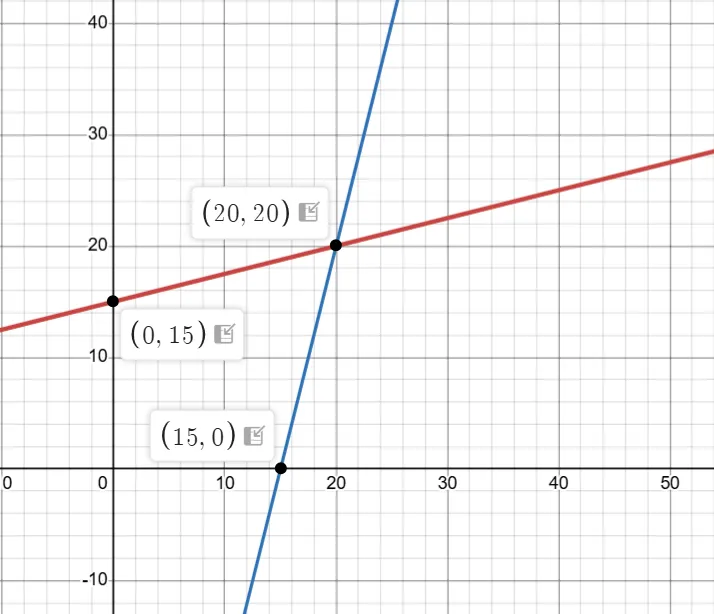
- Nash equilibrium is obtained when when and it meets both FOCs
- Nash equilibrium is (20, 20)
- Associated profits are (288, 288)
- Could the firms do better? (Collusion)
Collusive Game
Comments
- Fixing the prices to make bigger profits
- One model of collusion is: both Coke and Pepsi act as if they are under the same ownership
- Monopoly chooses both and to maximise (profits)
Optimisation Goal
| First-order condition w.r.t. | First-order condition w.r.t. |
|---|---|
Outcome
-
Clearly, firms prefer to collude to maximise profits
-
However, this is not a Nash equilibrium
- Even if firms agree to collude, they can gain from deviating if the other firm remains at
Positional Externalities
Definition
- People feel worse off when others obtain better or more of the same scarce goods
- This creates an “arms race” where everyone spends more just to keep up in relative standing
- The result is inefficient overconsumption and lower social welfare (e.g., bigger houses or expensive strollers)
Setup
-
2 candidates are running for office in a presidential election
-
Suppose P1 spends in campaigning, P2 spends in campaigning
-
This is a simultaneous choice game
-
P1’s and P2’s payoffs are:
Best Response Analysis
Verify that (0, 0) is not a Nash equilibrium
- Does not require calculus
- Just show that one player needs to deviate to gain
Perform best response analysis
- Assuming
FOC for P1
FOC for P2
Equality of FOC
- By comparing and , we can conclude that
- Thus, (2.5, 2.5) is a Nash equilibrium
Collusion
Assurance Game
Payoff Matrix
| P2 \ P1 | Red | Black |
|---|---|---|
| Red | 2, 2 | 0, 0 |
| Black | 0, 0 | 5, 5 |
- Nash Equilibria occur at and
- In this case, choosing might seem more logical since the payoff is higher than
- Pareto dominates , meaning that both players will be better off by doing so
- Pareto Efficiency: We say that is Pareto efficient if it is to not possible to find another outcome in the game where at least 1 player is better off and no other player is worse off
Stag Hunt Game
Payoff Matrix
| P2 \ P1 | Stag | Hare |
|---|---|---|
| Stag | 5, 5 | 0, 3 |
| Hare | 3, 0 | 4, 4 |
- Nash equilibria at and
- gives the Pareto efficient outcome
- is the risk-dominant Nash equilibrium
- Assuming that the other player will choose or with the same frequency:
- Choosing : Expected payoff is
- Choosing : Expected payoff is
Chicken Game
Payoff Matrix
| P2 \ P1 | Swerve | Straight |
|---|---|---|
| Swerve | 1, 1 | 0, 2 |
| Straight | 2, 0 | -1, -1 |
- Nash equilibria at and
- Both combinations of strategies are Pareto efficient
Evolutionary Biology
- Payoffs indicate expected off-springs
- Animals from same species (e.g. birds) meet at random
- Birds are genetically programmed to choose one strategy
- The strategy that gets more off-springs survives evolutionary pressures
- This represents a form of a mixed strategy