SMU H3 Map
- Content map: SMU H3 Game Theory Map
Ultimatum Game
Definition
A negotiation where one player makes a “take it or leave it” offer to another player.
- The person who offers is the proposer
- The person who answers is the recipient
Game Tree
-
Games can be represented as a combination of every choice made with every payoff made
-
Given the game tree below, we can conduct backward induction to identify the rollback equilibrium
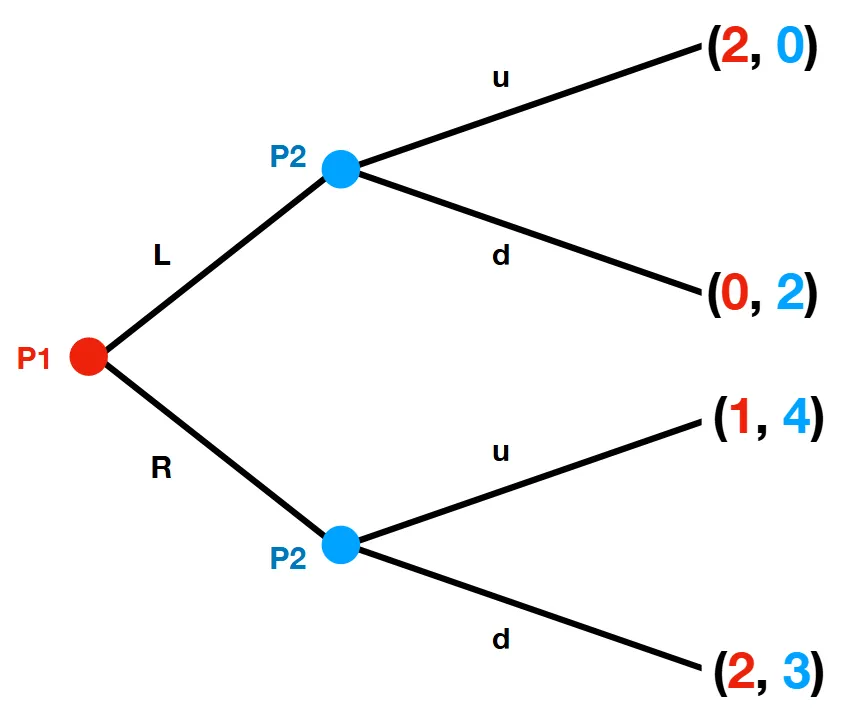
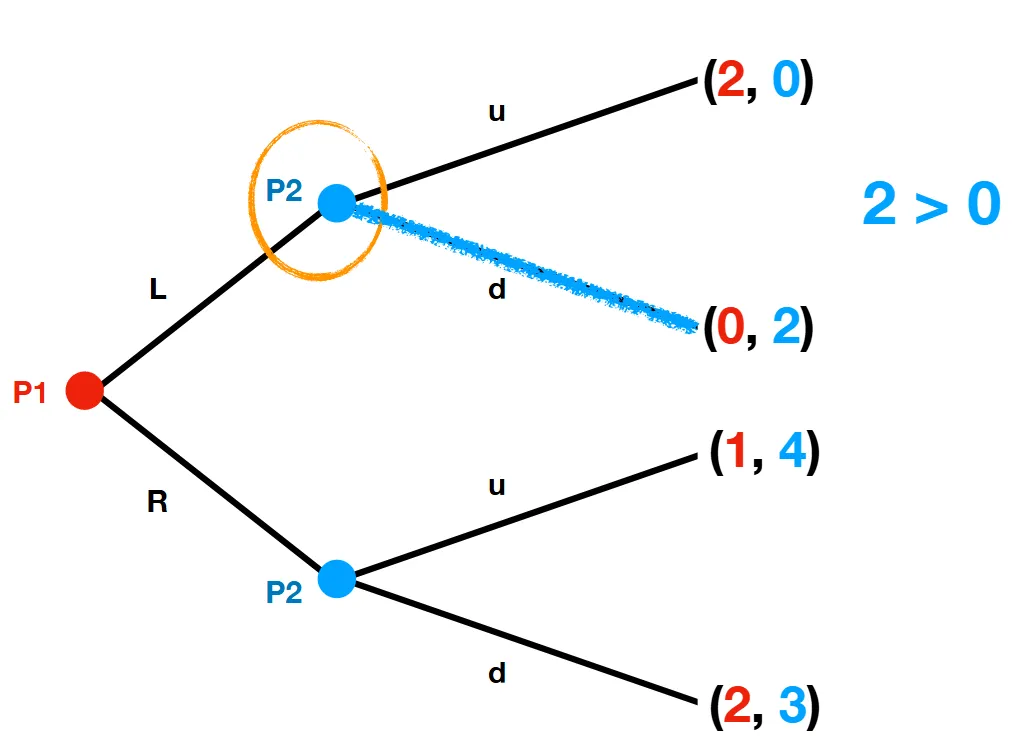
Rollback Equilibrium of Player 2
- Starting from the left subtree, the best outcome for this subtree is (0, 2)
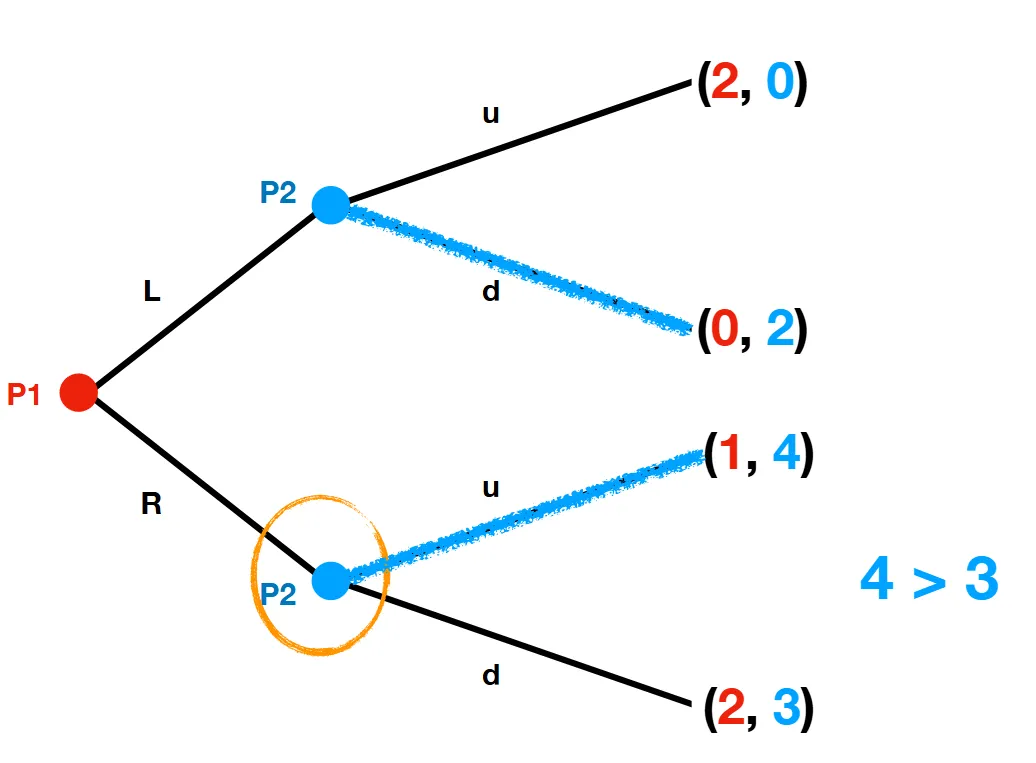
- For the right subtree, the best outcome for this subtree is (1, 4)
Strategies for a Player
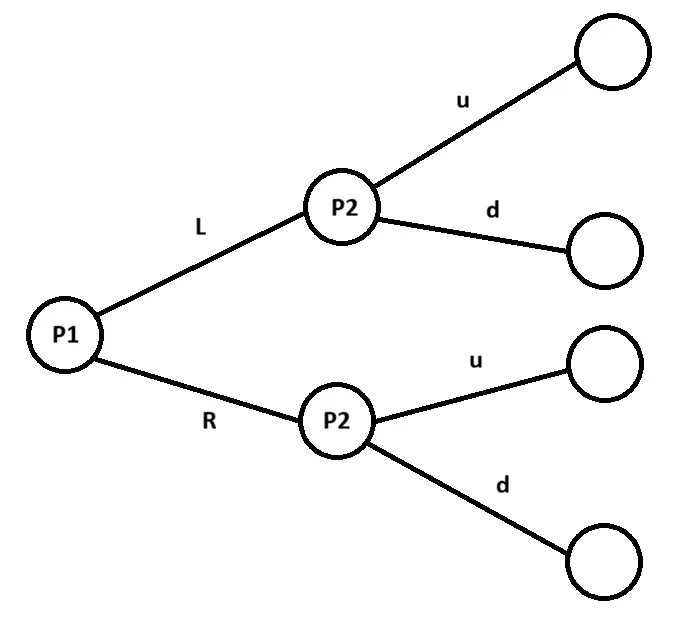
- P2’s strategies are a choice at each node
- Thus, the table below represents all the strategies for P2
- (u, u)
- (u, d)
- (d, u)
- (d, d)
Game
Rules
- The proposer chooses how many coins to give the recipient.
- The recipient can accept or reject.
- If the recipient rejects, both parties get nothing.
Ingredients
Players
- 2 players
- 1 proposer, 1 recipient
Information Structure
- One player moves first (proposer), then the second player (recipient).
- The recipient knows the proposer’s strategy when making the decision.
Strategy
- Proposer decides how much to offer.
- Recipient decides whether to accept or reject based on the amount.
Payoff
Let denote the proposed split.
- Proposer → if accepted, 0 otherwise
- Recipient → if accepted, 0 otherwise
Backward Induction
Let denote the proposed split.
Case 1: If
- Proposer →
- Recipient → , since
Case 2: If
- Recipient → 0 if accept, 0 if reject
- Proposer → 10 if accept, 0 if reject
Plausible Scenarios
-
Recipient accepts all offers
→ Proposer’s best split: -
Recipient accepts offers where payoff > 0
→ Proposer’s best split:
Rollback Equilibrium
Defined by the pair of strategies (one per player) that emerge from backward induction.
Scenarios
Extension 1: Inequality-Averse Recipient
Now assume the recipient cares about the difference:
instead of just .
Strategy
- Accept → Payoff =
- Reject → Payoff = 0
Optimal Strategy
Best answer is YES when:
Best answer is NO when:
Since , when the split is Both yes and no are equally optimal answers.
Rollback Equilibria
Moral of the Story
- In labs, the split ratios go from 50:50 to 60:40
- Monetary gains and losses might not be the only factor influencing
- Neuroeconomics can help in understanding these determinants
- The Neural Basis of Economic Decision-Making in the Ultimatum Game
- https://doi.org/10.1126/science.1082976
Extension 2: Counter-Offers
- What if the recipient can make a counter-offer?
Rules
- Agreeing to in the second round is payoff equivalent to agreeing to in the first round, where
- The pie to split has size 1, where any real number can be offered
- This means that :
- P1’s split is of the form
- P2’s split is of the form
Backward Induction
Round 2
- P2 offers a split of
- If yes, P1 obtains
- If no, P1 obtains
- Yes to any split since , thus
- P2 offers
Rollback to Round 1
- P1 proposes a split of
- If yes, P1 obtains
- If no, the game moves to stage 2, P2 will get
Conclusion
- P1’s best response is :
- Yes for all such that , which is equivalent to
- No otherwise
- The best split P1 can offer is
Rollback Equilibrium
P1’s Strategy
- In round 1, offer the split
- In round 2, accept any proposed split
P2’s Strategy
- In round 1, offer the split
- In round 2, accept any proposed split where
Entry Game
Rules
- Monopolist faces a threat by a challenger
- The challenger may decide to enter the market
- Upon entry, the monopolist will decide to price aggressively or cooperatively
- Monopolist prefers no entry to entry, and collusion to competition
- Challenger prefers entry only under collusion
Game Tree
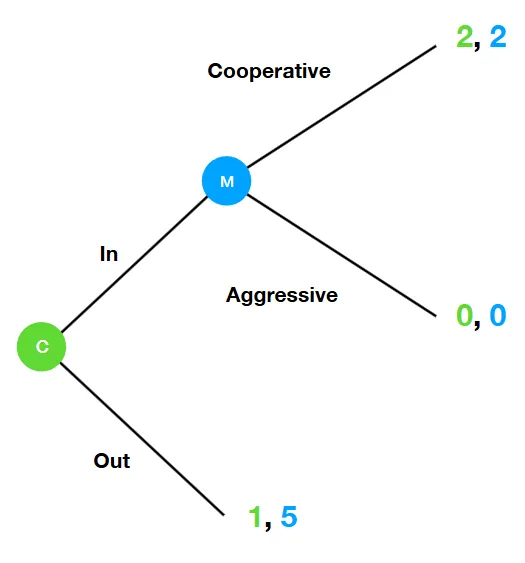
Rollback Equilibrium
- Challenger should enter the market, and cooperate to maximise payoff
- Monopolist can improve the outcome by cutting off the branch which results in the suboptimal rollback equilibrium
- This can be done by setting a precedent that they will not cooperate