- Content map: SMU H3 Game Theory Map
Setup
Definition:
Commitment Game / Sequential Decision Game
- Players: Two players, Ulysses before approaching the Sirens and Ulysses under the influence of the Sirens.
- Strategies: Player 1: Get Close or Stay Away; Player 2: Get Closer or Stay Safe if Player 1 gets close; Commitment version: Player 1 can remove Player 2’s option to Get Closer.
Rules
- Start with Ulysses choosing whether to approach the Sirens; Players move sequentially: pre-temptation Ulysses chooses access, then tempted Ulysses chooses whether to get closer.
- The player who commits before temptation avoids the dynamically inconsistent outcome.
- Player 1 first chooses whether to approach the coast.
- If Player 1 gets close, Player 2 chooses whether to get closer or stay safe; Payoffs are ordered as (Player 1, Player 2).
Game Tree
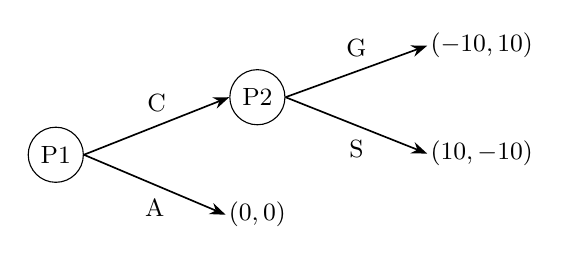
- Get Close, Stay Away, Get Closer, Stay Safe.
Derivation (Best Response Analysis)
- If Player 1 gets close, Player 2 compares from Get Closer with from Stay Safe.
- Player 2 chooses Get Closer.
- Anticipating this, Player 1 compares Stay Away payoff with Get Close payoff .
- Player 1 chooses Stay Away.
Derivation (Nash Equilibrium)
- Backward induction gives Player 2’s continuation action:
- Player 1’s optimal initial action is:
- The SGPE is therefore Stay Away, with the off-path continuation Get Closer.
Nash Equilibrium
Result:
Without commitment, the SGPE is: (Stay Away,Get Closer) with outcome . \newline With commitment, Ulysses ties himself and fills the crew’s ears with wax, removing Get Closer. The outcome becomes: (Get Close,Stay Safe) with payoff .
Social Optimum
- For Player 1, the best feasible outcome is Get Close and Stay Safe.
- Commitment makes that outcome reachable by removing the future temptation.
Insights
Insight:
- Commitment can solve a conflict between present and future selves.
- Tying oneself removes the future self’s harmful action.
- The strategic move changes the SGPE outcome.