- Content map: SMU H3 Game Theory Map
Setup
Definition:
Ultimatum Game with a Non-Credible Threat
- Players: Two players, Sender / proposer and Receiver / responder.
- Strategies: Sender chooses an offer to give the receiver from a pie of size ; Receiver chooses Accept or Reject after every possible offer; Threat strategy: reject any offer with .
Rules
- Start with a fixed pie and a threatened rejection rule; Players move sequentially: the sender offers , then the receiver accepts or rejects.
- The player who ignores non-credible off-path threats reaches the subgame-perfect outcome.
- If the receiver accepts offer , payoffs are ; If the receiver rejects, payoffs are .
- Payoffs are ordered as (Sender, Receiver).
Game Tree
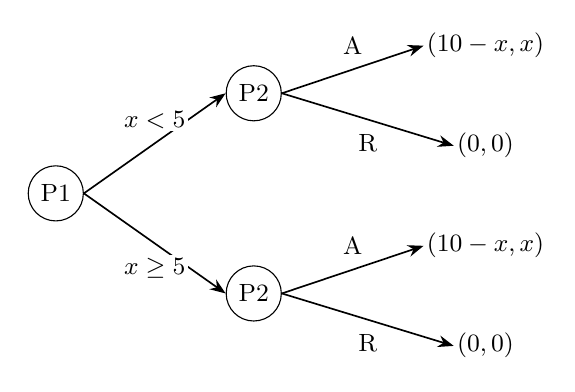
Derivation (Best Response Analysis)
- If , the receiver strictly prefers Accept because .
- If , the receiver is indifferent between Accept and Reject.
- Rejecting is therefore not sequentially rational.
- If the sender believes the receiver rejects all , the sender’s best accepted offer is .
Derivation (Nash Equilibrium)
- Strategy profile:
- Given the receiver’s strategy, offering less than gives sender payoff .
- Offering gives sender payoff .
- Offering more than gives sender payoff below .
- Thus offering is a best response to the receiver’s threat strategy.
- Given offer , the receiver accepts and receives , so the receiver does not gain by deviating on the equilibrium path.
- Hence the profile is a Nash equilibrium.
Nash Equilibrium
Result:
The profile
is a Nash equilibrium, but it is not subgame perfect because rejecting is not credible.
Insights
Insight:
- A threat can support a Nash equilibrium without being credible.
- SGPE removes the threat because the receiver would not carry it out after a positive offer below .
- Strategic moves are needed to make such threats credible.