- Content map: SMU H3 Game Theory Map
Setup
Definition:
Sequential Ultimatum Game
- Players: P1 and P2.
- Strategies: P1: choose an offer . Since P1 moves once in the base game, the chosen proposal is the complete pure strategy; P2: a complete contingent response rule for every possible offer .
- Rules:
- Start with a fixed surplus .
- Players move sequentially: P1 offers to P2, then P2 accepts or rejects.
- The player who chooses optimally by backward induction reaches the subgame-perfect outcome.
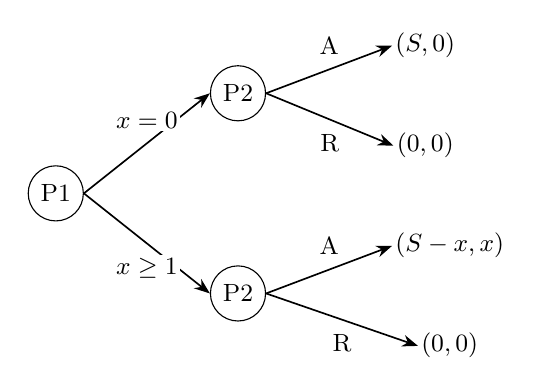
Game Tree
Derivation (Backward Induction)
- For any , P2 strictly prefers Accept since .
- At , P2 is indifferent: Accept and Reject both yield .
- Anticipating P2’s rule, P1 chooses the smallest that will be accepted.
Nash Equilibrium
Result:
- When , P2 accepts the split.
- When , P2 is indifferent to accept or reject.
Insights
Insight:
Backward induction selects minimal concession by the proposer: the responder’s ability to punish is limited by what is optimal at the moment of choice.
Extension: Counter-Offers
Setup
Definition:
Two-Round Ultimatum Game with two players
- Start with a first-round proposal and a possible discounted counter-offer round.
- Players alternate proposing and responding across the reached rounds.
- The player who chooses optimally by backward induction reaches the rollback outcome.
Game Tree
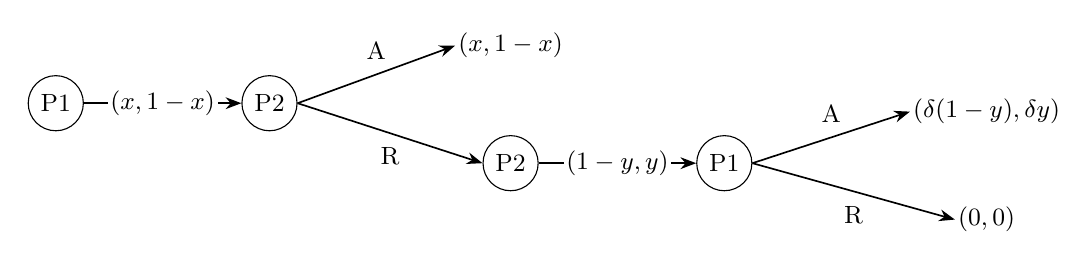
Round 2
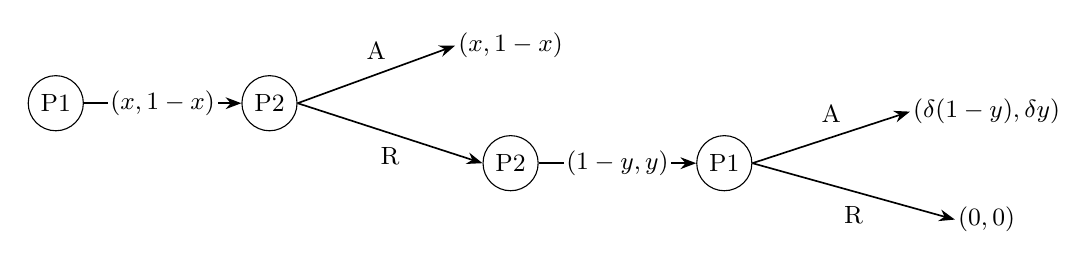
- P2 proposes .
- If P1 accepts, first-round equivalent payoffs are:
- If P1 rejects, both players obtain .
- Since , P1 weakly prefers accepting any round-2 offer.
- Therefore P2 chooses , so the round-2 outcome is:
Rollback to Round 1
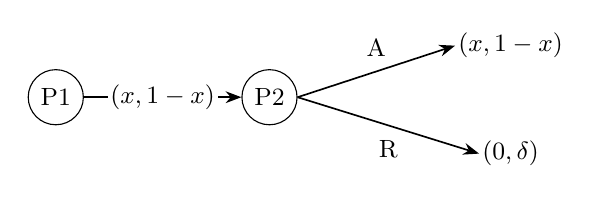
- In round 1, P2 compares:
- accept P1’s offer and receive ,
- reject and move to round 2, where P2 receives .
- Hence P2 accepts if and only if:
- Equivalently:
- P1 maximises own share , so chooses the largest acceptable value:
- Thus the round-1 offer is:
Nash Equilibrium
Result:
The subgame perfect Nash equilibrium of the two-round counter-offer extension is:
- P1: Offer in round 1; Accept all round-2 offers.
- P2: Accept if in ; Otherwise reject; in round 2, offer .
Insights
Insight:
Allowing a counter-offer strengthens P2’s outside option from to . As rises, P2 becomes more patient and captures a larger share of the pie.