- Content map: SMU H3 Game Theory Map
Setup
Definition:
Commitment Game
- Players: Two players, Teacher and Student.
- Strategies: Teacher: Weak or Tough; Student: Punctual or Late; Commitment version: Teacher can commit to Tough before the student chooses.
Rules
- Start with a teacher and student facing a punctuality problem; Players choose Weak or Tough and Punctual or Late, with possible prior commitment to Tough.
- The player who commits credibly or best responds to commitment reaches the preferred outcome.
- Without commitment, teacher and student play the payoff matrix below.
- With commitment, the teacher removes Weak from the later choice set; Payoffs are ordered as (Teacher, Student).
Game Tree
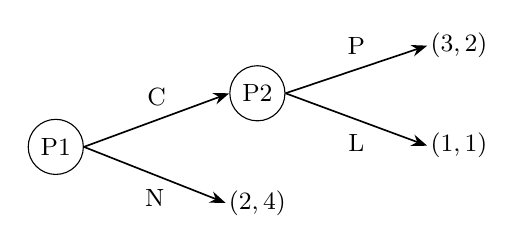
- Commit to Tough, No Commit, Punctual, Late.
Payoff Matrix
| Punctual | Late | |
|---|---|---|
| Weak | 4, 3 | 2, 4 |
| Tough | 3, 2 | 1, 1 |
Derivation (Best Response Analysis)
- Teacher:
- If Student is Punctual, Teacher prefers Weak since .
- If Student is Late, Teacher prefers Weak since .
- Weak is a dominant strategy for Teacher.
- Student:
- If Teacher is Weak, Student prefers Late since .
- If Teacher is Tough, Student prefers Punctual since .
Derivation (Nash Equilibrium)
- In the no-commitment game, Teacher chooses Weak.
- Given Weak, Student chooses Late.
- The Nash equilibrium is therefore (Weak,Late) with payoff .
- If Teacher commits to Tough, Student chooses Punctual because .
- Teacher then receives instead of the no-commitment payoff .
- Therefore commitment improves Teacher’s payoff.
Nash Equilibrium
Result:
Without commitment:
With commitment:
leading to the Tough-Punctual outcome .
Social Optimum
- The largest total payoff is at (Weak,Punctual):
- The commitment outcome (Tough,Punctual) gives total payoff .
- Commitment helps Teacher but does not maximise total surplus.
Insights
Insight:
- Commitment can require adopting a dominated action.
- Credibility is key because the teacher must enforce Tough behaviour when the student is late.
- External rules can make the commitment credible.