- Content map: SMU H3 Game Theory Map
Setup
Definition:
Zero-Sum Poker Signalling Game
- Players: Player 1, Player 2, and Nature.
- Strategies: Nature draws a card for each player, or ; Player 1 observes own card and chooses Pass or Raise; after a raise, Player 2 chooses Fold or Stay.
- Rules: Each card is high or low with equal probability; cards are shown at the end; the higher card wins; win payoff is , loss payoff is , and a tie gives .
Payoff Details
- The four card states are
- Since each player receives or with probability , each state occurs with probability
- If Player 1 passes, cards are shown and the higher card wins:
- If Player 1 raises and Player 2 folds, the extracted tree gives
in every state
- If Player 1 raises and Player 2 stays, the extracted tree gives:
- The game is zero-sum in every terminal node.
Game Tree
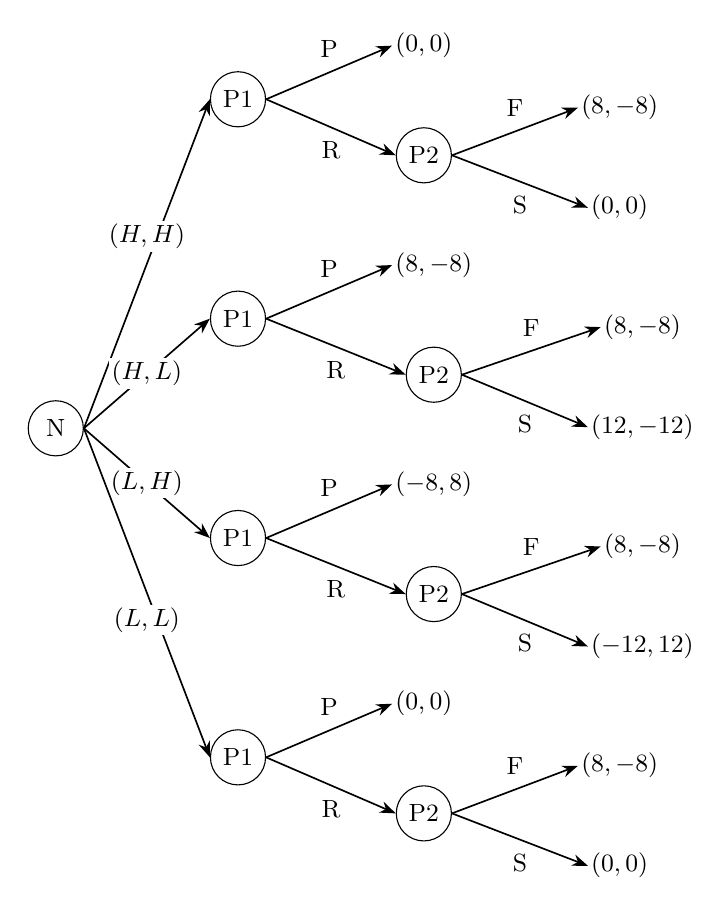
Payoff Matrix
- Not used: the extracted material is an extensive-form poker tree rather than a compact normal-form matrix.
Derivation (Best Response Analysis)
Player 2 after a raise
- In state , folding gives and staying gives , so Player 2 prefers Stay.
- In state , folding gives and staying gives , so Player 2 prefers Fold.
- In state , folding gives and staying gives , so Player 2 prefers Stay.
- In state , folding gives and staying gives , so Player 2 prefers Stay.
Player 1 before the response
- With card pair , raising can improve Player 1’s payoff from to if Player 2 stays.
- With card pair , raising can improve Player 1’s payoff from to if Player 2 folds, but can also reduce it to if Player 2 stays.
- In tied states and , passing and a raise followed by stay both give , while a fold after the raise gives Player 1 payoff .
- Hence the strategic tension is bluffing by Player 1 versus calling by Player 2.
Zero-sum structure
- Every terminal payoff is of the form
- So one player’s gain is exactly the other player’s loss.
Nash Equilibrium
Result:
The extracted notes specify the full extensive-form game tree and terminal payoffs, but they do not provide a solved equilibrium strategy profile.
Social Optimum
- Not used: this is a zero-sum game, so there is no separate cooperative benchmark distinct from the strategic payoffs.
Insights
Insight:
- The game is a simple poker-style signalling problem: Player 1 acts after seeing a card, and Player 2 reacts to the raise.
- Raising with a low card creates a bluffing incentive because Player 2 may fold.
- Staying against a raise is valuable only when Player 2’s card is strong enough.
- Zero-sum structure makes the game suitable for mixed-strategy analysis.