- Content map: SMU H3 Game Theory Map
Setup
Definition:
Finite Perfect-Information Game
- Players: Player 1 and Player 2.
- Strategies: Player 1 chooses L or R; Player 2 chooses u or d at the reached node.
- Rules: Player 2 observes Player 1’s move, and optimal play is found by backward induction.
Game Tree
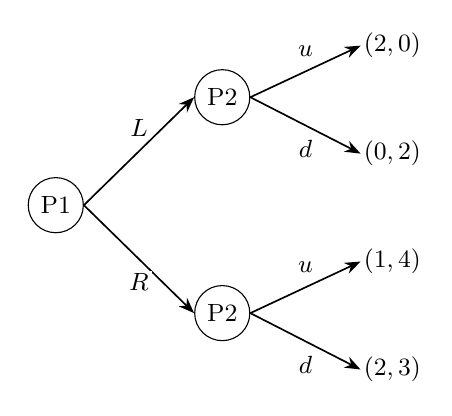
Payoff Details
Derivation (Backward Induction)
- After , Player 2 compares the second payoff from and : vs . Hence Player 2 chooses after .
- After , Player 2 compares the second payoff from and : vs . Hence Player 2 chooses after .
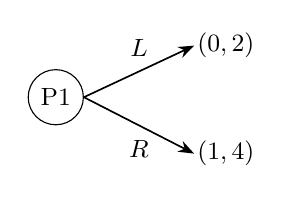
- Anticipating Player 2’s optimal continuation actions, Player 1 compares the first payoff from and : vs .
- Hence Player 1 chooses .
Nash Equilibrium
Result:
A subgame perfect Nash equilibrium strategy profile is:
Insights
Insight:
In sequential games, strategies must specify actions at every contingency.
Backward induction selects optimal actions in every subgame.