- Content map: SMU H3 Game Theory Map
Setup
Definition:
Sequential Extensive Form Game
- Players: Two players, Player 1 and Player 2.
- Strategies: Player 1: Up / Down; Player 2: contingent strategies , , , .
Rules
- Start with Player 1 at the initial decision node.
- Players move sequentially: Player 1 chooses Up or Down, then Player 2 chooses Left or Right at the reached node.
- The player who chooses optimally by backward induction reaches the subgame-perfect outcome.
- Player 1 moves first
- Player 2 observes and responds
Game Tree
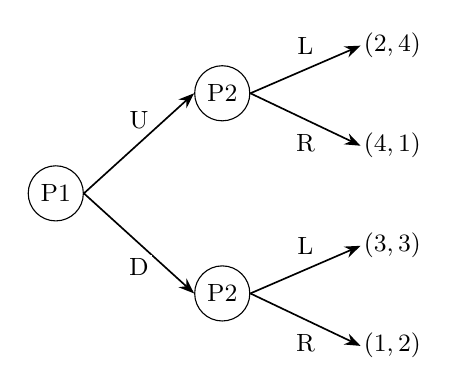
Payoff Matrix
| LL | LR | RL | RR | |
|---|---|---|---|---|
| Up | 2, 4 | 2, 4 | 4, 1 | 4, 1 |
| Down | 3, 3 | 1, 2 | 3, 3 | 1, 2 |
- In Player 2’s contingent strategy, the first action is after Up and the second action is after Down.
Derivation (Best Response Analysis)
- After Up, Player 2 compares Left and Right:
- Left gives
- Right gives
- So Player 2 chooses Left after Up.
- After Down, Player 2 compares Left and Right:
- Left gives
- Right gives
- So Player 2 chooses Left after Down.
- Hence Player 2’s sequentially rational contingent strategy is .
- Given , Player 1 compares:
- Up gives
- Down gives
- So Player 1 chooses Down.
Derivation (Nash Equilibrium)
- Player 1’s best responses in the strategic form are:
- to : Down, since
- to : Up, since
- to : Up, since
- to : Up, since
- Player 2’s best responses are:
- to Up: and , since Left gives
- to Down: and , since Left gives
- Strategic-form Nash equilibria are (Down,LL) and (Up,LR).
- Only (Down,LL) is subgame perfect because after Down, Right is not optimal for Player 2.
Nash Equilibrium
Result:
Nash Equilibria: (Down,LL) and (Up,LR)
Subgame Perfect Nash Equilibrium: (Down,LL)
Equilibrium Path:
Down then Left, with payoff .
Social Optimum
- Joint payoff is at (Up,L) and (Down,L).
- So both Left outcomes are socially efficient.
Insights
Insight:
- Strategies must specify actions at all nodes
- Off-path actions matter for equilibrium