- Content map: SMU H3 Game Theory Map
Setup
Definition:
Second-Price Common Value Auction with Independent Signals
- Players: Two bidders: bidder and bidder .
- Strategies: Each bidder observes own signal ; Each bidder chooses a bid ; A symmetric strategy is a function .
Rules
- Two bidders observe independent signals and simultaneously submit sealed bids.
- Signals are independently drawn from .
- The common value is:
- The highest bidder wins; the winner pays the second-highest bid; losing bidders receive payoff .
Derivation (Verification by Expected Payoff FOC)
Candidate strategy
- Candidate symmetric strategy:
- Suppose bidder uses .
- Bidder with signal considers bid .
- Bidder wins when
- If bidder wins, the price is and payoff is
- Since ,
- Expected payoff is
- Therefore
- Compute:
- Maximise
- The first-order condition is
- Hence
- For , the derivative is positive; For , the derivative is negative.
- The candidate strategy is a best response to itself.
Nash Equilibrium
Result:
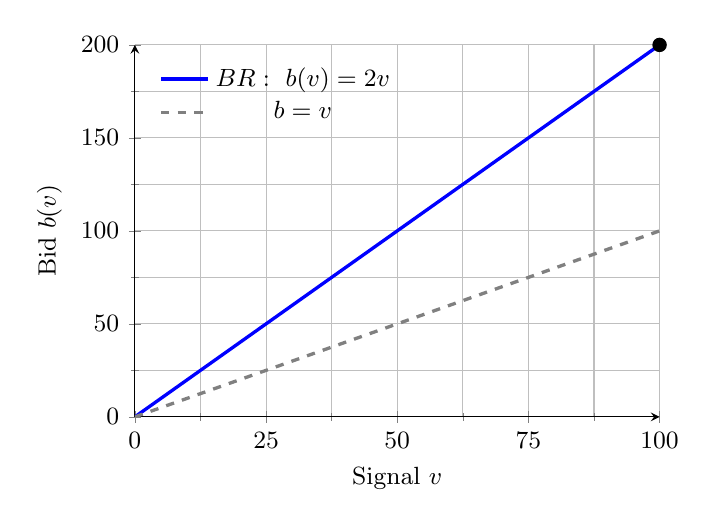
The symmetric equilibrium bidding function is
Social Optimum
- Since is common after both signals are known, either bidder has the same ex-post value for the object.
- The auction mainly determines payments and information aggregation, not ex-post allocation efficiency.
Diagram (Best Response Functions)
Insights
Insight:
- Truthful private-value bidding does not apply in common-value auctions.
- The winner pays the expected opponent signal inferred from the second-highest bid.
- The bidder accounts for the information contained in winning.
- In this example, the second-price common-value bid is twice the private signal.