- Content map: SMU H3 Game Theory Map
Setup
Definition:
Risk-Sharing under External Uncertainty
- Players: Two players, Agent 1 and Agent 2.
- Strategies: No agreement: each agent keeps their realised payoff; Risk-sharing agreement: the lucky agent transfers to the unlucky agent; Insurance: the agent pays a premium to remove the risky payoff.
Rules
- Start with two agents facing negatively correlated risky outcomes; Players choose no agreement, risk sharing, or insurance arrangements.
- The player who smooths consumption when utility is concave improves expected utility.
- The agents are engaged in similar activities in different geographical areas; Their outcomes are negatively correlated: if things go well for one agent, they go badly for the other.
- Each agent faces a good outcome and a bad outcome with equal probability.
- Without agreement, the good state pays and the bad state pays ; With risk sharing, the lucky agent pays to the unlucky agent.
Payoff Details
& Good & Bad \ No agreement & & \ Probability & & \ Risk-sharing agreement & & \ Probability & &
Derivation (Best Response Analysis)
- Without agreement, expected monetary payoff is:
- With risk sharing, expected monetary payoff is:
- Expected value is unchanged.
- Risk is eliminated because each agent receives for sure.
- A risk-neutral agent is indifferent between the two arrangements.
- A risk-averse agent strictly prefers the risk-sharing agreement.
Utility and Risk Aversion
- Suppose utility is:
- Expected utility without risk sharing is:
- Expected utility with risk sharing is:
- The same expected monetary payoff gives higher utility when risk is removed.
Insurance
- Insurance companies take on risk in exchange for payment.
- The certainty equivalent is the guaranteed payoff giving the same utility as the risky lottery.
- Since , receiving for sure gives the same utility as the risky payoff.
- Maximum willingness to pay for full insurance is:
- The agent is willing to pay up to to eliminate the risk.
Graph Interpretation
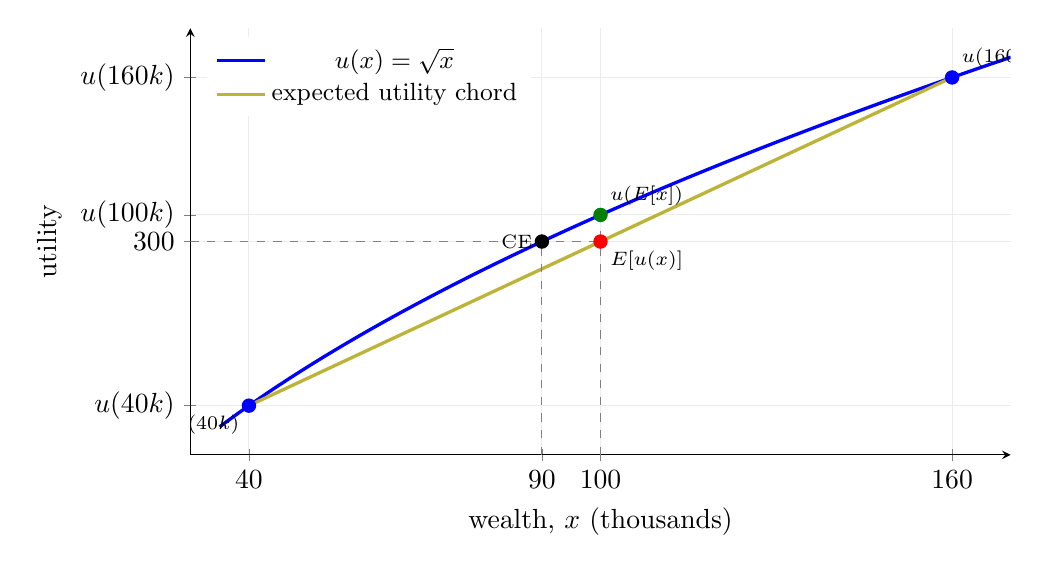
- The blue curve is utility, .
- The yellow chord is the linear combination of utilities across risky states.
- The chord connects and .
- Its equation is:
- If the good state occurs with probability , expected wealth is:
- Substituting this into the chord gives:
- At , the chord gives expected utility .
- The curve gives utility of expected wealth, .
- Since utility is concave:
Derivation (Nash Equilibrium)
- If both agents are risk averse, both prefer risk sharing to no agreement.
- The agreement is mutually beneficial because each agent gets the expected payoff for sure.
- The agreement works because their risks move in opposite directions.
Nash Equilibrium
Result:
For risk-averse agents, the risk-sharing agreement is the stable outcome: the lucky agent pays to the unlucky agent, and both receive for sure.
Social Optimum
- Expected total payoff is unchanged by the transfer.
- Welfare rises for risk-averse agents because uncertainty is removed.
- The social optimum is full risk sharing: both agents receive the certain payoff .
Insights
Insight:
- Risk sharing eliminates uncertainty without changing expected value.
- Risk-averse individuals prefer certainty.
- Insurance pricing reflects the gap between expected value and certainty equivalent.
- Expected utility lies on the chord, not on the utility curve.