- Content map: SMU H3 Game Theory Map
Setup
Definition:
Continuous Contribution Public Good Game
- Players: players.
- Strategies: Each player chooses a contribution .
Rules
- Start with each player endowed with units; Players simultaneously choose contributions to a common pool.
- The player who chooses the payoff-maximising contribution against others’ contributions is optimal.
- Each player is endowed with units of a private asset; Contributions are added to a common pool.
- Payoffs are realised simultaneously after all contributions are chosen.
Payoff Matrix
- Player ‘s payoff is
- Rewriting:
Derivation (Best Response Analysis)
- Holding other contributions fixed, player ‘s problem is
- The derivative with respect to own contribution is
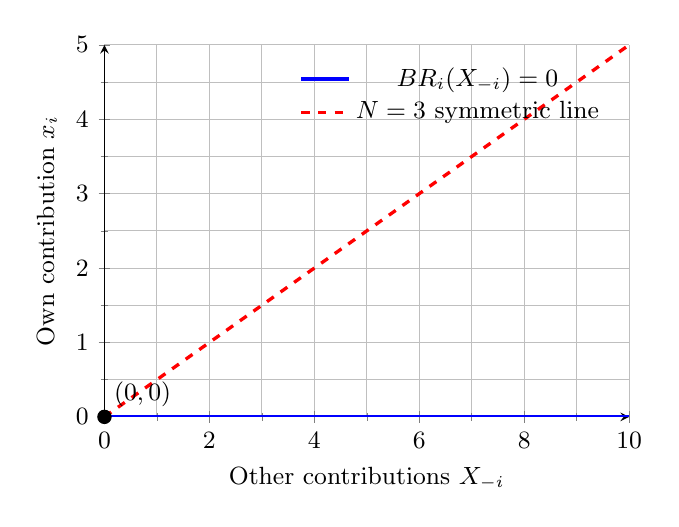
- Therefore payoff falls as increases, so the best response is the boundary choice
Derivation (Nash Equilibrium)
- Since every player’s best response is , the unique Nash equilibrium is
- To find the social optimum, maximise total welfare:
- Because , the coefficient on each is positive.
- Therefore welfare is maximised by setting every contribution at the upper bound:
Nash Equilibrium
Result:
The unique Nash equilibrium is zero contribution by every player:
Social Optimum
- The welfare-maximising outcome is full contribution by every player:
- The gap between equilibrium and optimum is the free-rider problem.
Diagram (Best Response Functions)
- Diagram shown for the symmetric projection with , so on symmetric profiles.
Insights
Insight:
- Each player bears the full private cost of contribution but captures only part of the social benefit.
- This is the continuous-strategy analogue of a Prisoner’s Dilemma.