- Content map: SMU H3 Game Theory Map
Setup
Definition:
Sequential Bargaining and Voting Game
- Players: Five pirates ordered by seniority: , , , , and .
- Strategies: A proposer chooses an allocation of 100 coins among the survivors; Each voter chooses Yes or No after seeing the proposal; Preferences are lexicographic: Survival, Coins, Fewer Rivals.
Rules
- Start with five pirates dividing coins by seniority; Players alternate proposing allocations and voting Yes or No among survivors.
- The player who forms a passing coalition survives with the proposed allocation.
- If a proposal passes, the game ends; If it fails, the proposal is killed and the next pirate proposes.
- If a tie in payoffs occurs, the proposer is accepted
- With survivors, the proposer needs only enough votes to avoid losing.
Game Tree
Legend:
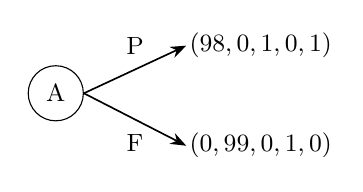
- Pass (P): Proposal accepted
- Fail (F): Proposer killed
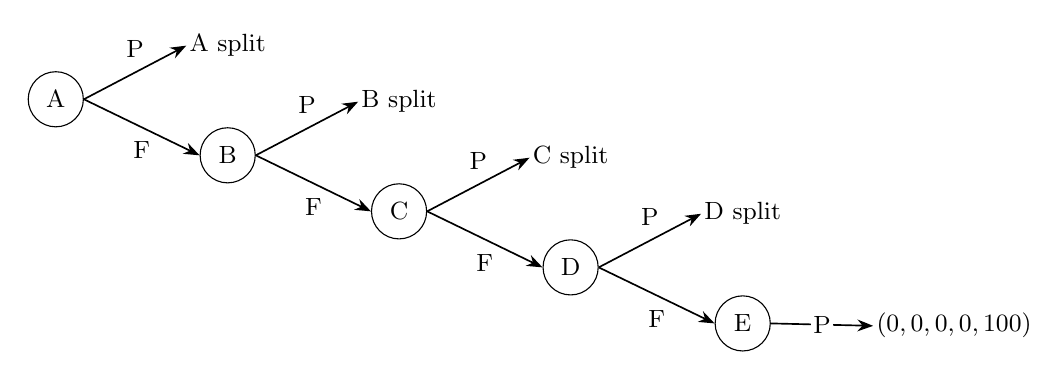
Payoff Details
\renewcommand{\arraystretch}{1.3} Survivors & Rollback proposal \ & \ & \ & \ & \ &
- Each vector is written in the order .
Derivation (Backward Induction)
Step 1: Only survives
- No vote is needed; keeps all 100 coins, so the rollback outcome is .
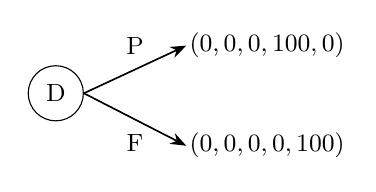
Step 2: proposes to
- If is killed, Step 1 gives .
- votes Yes on his own proposal; a - tie passes, so needs no extra vote.
- maximises own coins by proposing ; can vote No, but the proposal still passes.
Step 3: proposes to
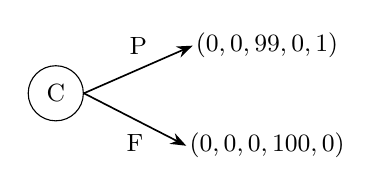
- If is killed, Step 2 gives continuation payoffs .
- gets 100 after rejection, so rejects any offer below 100; gets 0, so 1 coin makes prefer acceptance.
- With three survivors, needs one extra vote besides his own; the cheapest pivotal vote is for 1 coin.
- proposes .
Step 4: proposes to
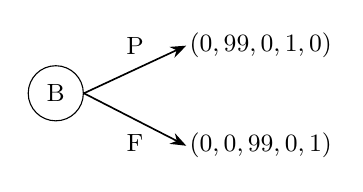
- If is killed, Step 3 gives continuation payoffs .
- gets 99 after rejection, so needs more than 99; gets 1, so needs more than 1.
- gets 0 after rejection, but 0 now ties on coins and rejection leaves fewer rivals, so needs 1.
- With four survivors, needs one extra vote because a - tie passes; the cheapest pivotal vote is for 1 coin.
- proposes .
Step 5: proposes to
- If is killed, Step 4 gives continuation payoffs .
- gets 99 after rejection, so needs more than 99; gets 1, so needs more than 1.
- and each get 0 after rejection, so each can be bought with 1 coin.
- With five survivors, needs two extra votes besides his own; the cheapest pivotal votes are and for 1 coin each.
- proposes .
Derivation (Nash Equilibrium)
- With all five pirates, needs two extra votes.
- The cheapest votes are and , so proposes
- , , and vote Yes, so the proposal passes -.
Nash Equilibrium
Result:
The rollback equilibrium proposal is
It passes immediately with votes from , , and .
Social Optimum
- Total coins always sum to 100.
- The game is about survival and distribution, not surplus creation.
Insights
Insight:
- Backward induction turns the five-pirate problem into a chain of smaller voting games.
- A proposer buys the cheapest pivotal votes, not the friendliest pirates.
- The tie rule is decisive because it lowers the number of votes the proposer must buy.