- Content map: SMU H3 Game Theory Map
Setup
Definition:
Continuous competition game / Bertrand pricing with perfect substitutes
- Players: Two players, Firm 1 and Firm 2.
- Strategies: Firm 1 chooses price ; Firm 2 chooses price .
Rules
- Start with two firms selling perfect substitutes at constant marginal cost; Players simultaneously choose prices.
- The player who undercuts profitably captures demand.
- Market demand is ; Marginal cost is .
- Consumers buy from the lower-price seller because the products are perfect substitutes.
- If prices tie, firms split demand equally.
Payoff Details
- Firm 1’s quantity is:
- Firm 2’s quantity is defined symmetrically.
Diagram (Demand Jump at )
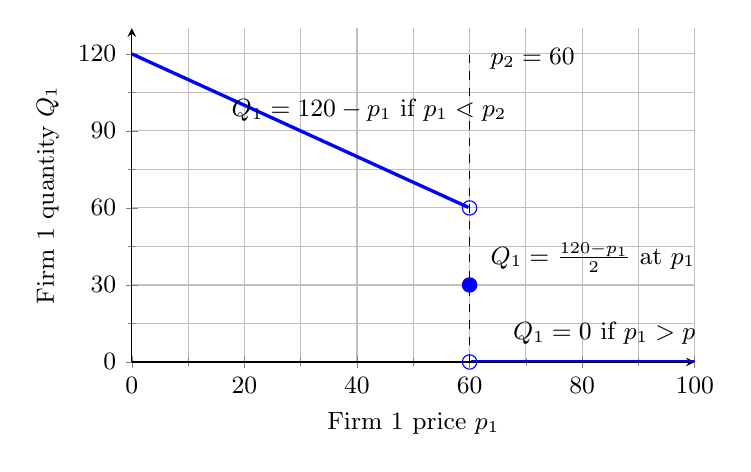
- The graph fixes to illustrate the discontinuity.
- A tiny undercut moves Firm 1 from half the market to the whole market.
Derivation (Best Response Analysis)
- Firm 1’s profit is .
- Calculus is not the right tool here because jumps at .
- If , Firm 1 can set a slightly lower price with small, capture the whole market, and earn positive profit.
- If , undercutting would require selling below marginal cost, so winning the market is unprofitable.
- If , any lower price gives negative margin and any higher price yields zero demand.
- Therefore the only price that can survive best-response logic is the marginal-cost price.
Derivation (Nash Equilibrium)
-
Suppose both firms charge the same price above .
- Either firm can undercut by a tiny amount, capture the whole market, and raise profit.
- So no common price above can be a Nash equilibrium.
-
Suppose one firm charges a higher price than the other.
- The high-price firm sells nothing, so that profile is not stable against deviation.
- Suppose both firms charge .
- Undercutting below gives negative margin, while raising price above loses all customers.
Nash Equilibrium
Result:
The Bertrand equilibrium is
Insights
Insight:
- Perfect substitutes create aggressive undercutting incentives.
- The discontinuity in demand means first-order conditions are not useful.
- Competition drives price down to marginal cost.