- Content map: SMU H3 Game Theory Map
Setup
Definition:
Coordination Game with Mixed Equilibrium
- Players: Two players, Player 1 and Player 2.
- Strategies: Player 1: or ; Player 2: or .
Rules
- Start with a coordination payoff matrix.
- Players simultaneously choose one of two actions or mix between them.
- The player who coordinates or mixes at the indifference probability is optimal.
- Players move simultaneously.
- Each player prefers to match on a different diagonal outcome, but both prefer coordination to mismatch.
Payoff Matrix
| L | R | |
|---|---|---|
| U | 3, 4 | 0, 0 |
| D | 0, 0 | 4, 3 |
Derivation (Best Response Analysis)
- Let be the probability that Player 2 chooses .
- Player 1’s expected payoff from is .
- Player 1’s expected payoff from is .
- Therefore:
- if , Player 1 prefers ,
- if , Player 1 prefers ,
- if , Player 1 is indifferent.
- Solving gives
- Let be the probability that Player 1 chooses .
- Player 2’s expected payoff from is .
- Player 2’s expected payoff from is .
- Therefore:
- if , Player 2 prefers ,
- if , Player 2 prefers ,
- if , Player 2 is indifferent.
- Solving gives
Derivation (Nash Equilibrium)
- Pure-strategy mutual best responses occur at:
- ,
- .
- A mixed equilibrium requires both players to be indifferent:
- The best-response correspondences intersect at , , and in -space.
- Therefore, in the strategy orders for Player 1 and for Player 2, the mixed equilibrium profile is
Diagram (Best Response Functions)
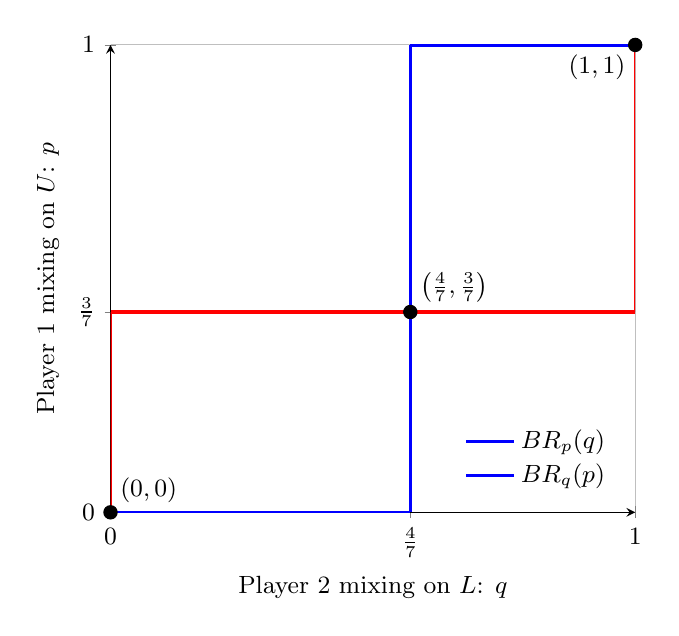
Nash Equilibrium
Result:
The game has three Nash equilibria:
- two pure equilibria: and ,
- one mixed equilibrium:
where the strategy orders are for Player 1 and for Player 2.
Social Optimum
- yields total payoff .
- yields total payoff .
- Off-diagonal outcomes yield total payoff .
- Both pure equilibria are socially optimal relative to mismatch.
Insights
Insight:
- Mixed equilibrium arises because each player uses probabilities to keep the other indifferent.
- The mixed equilibrium is not a compromise outcome. It is a strategic randomisation over competing coordination points.