Symmetric 3×3 simultaneous-move game with full-support and support-restricted mixing
Players: Two players, Player 1 and Player 2.
Strategies: Each player chooses A, B, or C.
Rules
Start with a symmetric 3×3 payoff matrix; Players simultaneously choose pure strategies or mix over supports.
The player who makes the opponent indifferent over the relevant support reaches mixed equilibrium.
Players move simultaneously.
Diagonal outcomes give payoffs 1, 2, and 3 at (A,A), (B,B), and (C,C); The off-diagonal entries below are a compact formalisation consistent with the visible support-analysis results in the lecture notes.
Payoff Matrix
A
B
C
A
1, 1
1, 0
0, 0
B
0, 1
2, 2
1, 0
C
0, 0
0, 1
3, 3
Derivation (Best Response Analysis)
Against A, Player 1 compares 1,0,0, so BR1(A)=A.
Against B, Player 1 compares 1,2,0, so BR1(B)=B.
Against C, Player 1 compares 0,1,3, so BR1(C)=C.
By symmetry, BR2(A)=A, BR2(B)=B, and BR2(C)=C.
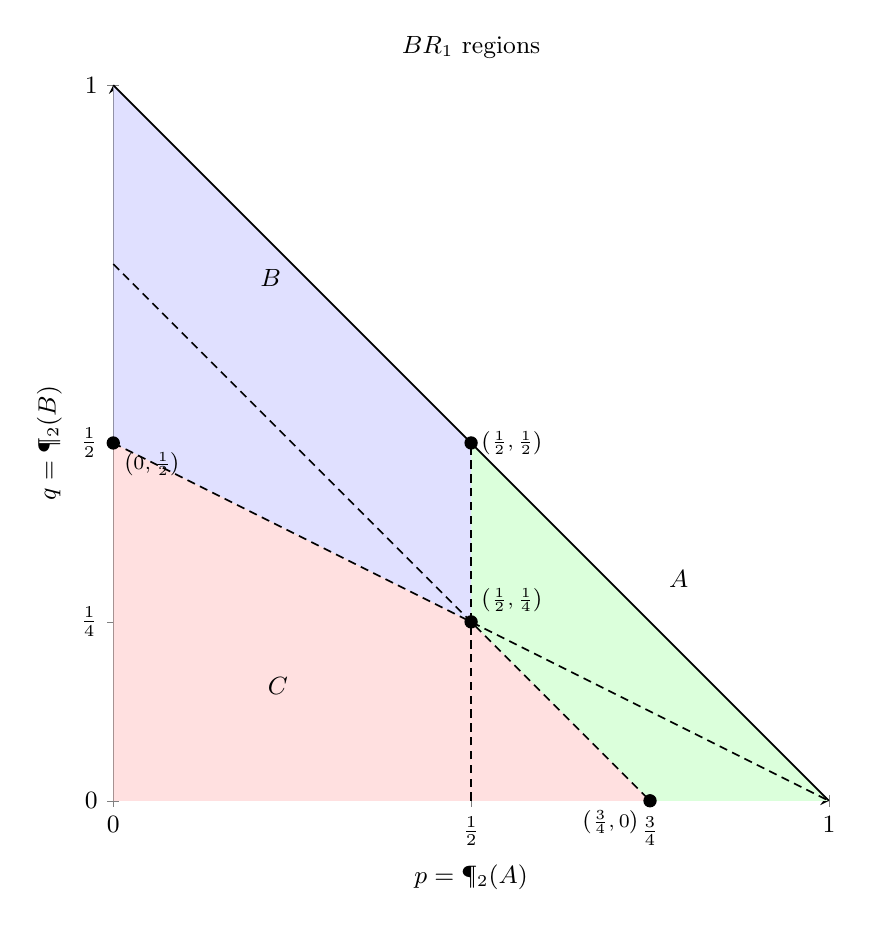
Let Player 2 mix with probabilities (p,q,1−p−q) on (A,B,C). Then Player 1’s expected payoffs are:
BR1(p,q)=⎩⎨⎧ABC{A,B}{A,C}{B,C}{A,B,C}if p>21 and p+q>43,if p<21 and p+2q>1,if p+q<43 and p+2q<1,if p=21,q>41,if p+q=43,p>21,if p+2q=1,p<21,if (p,q)=(21,41).
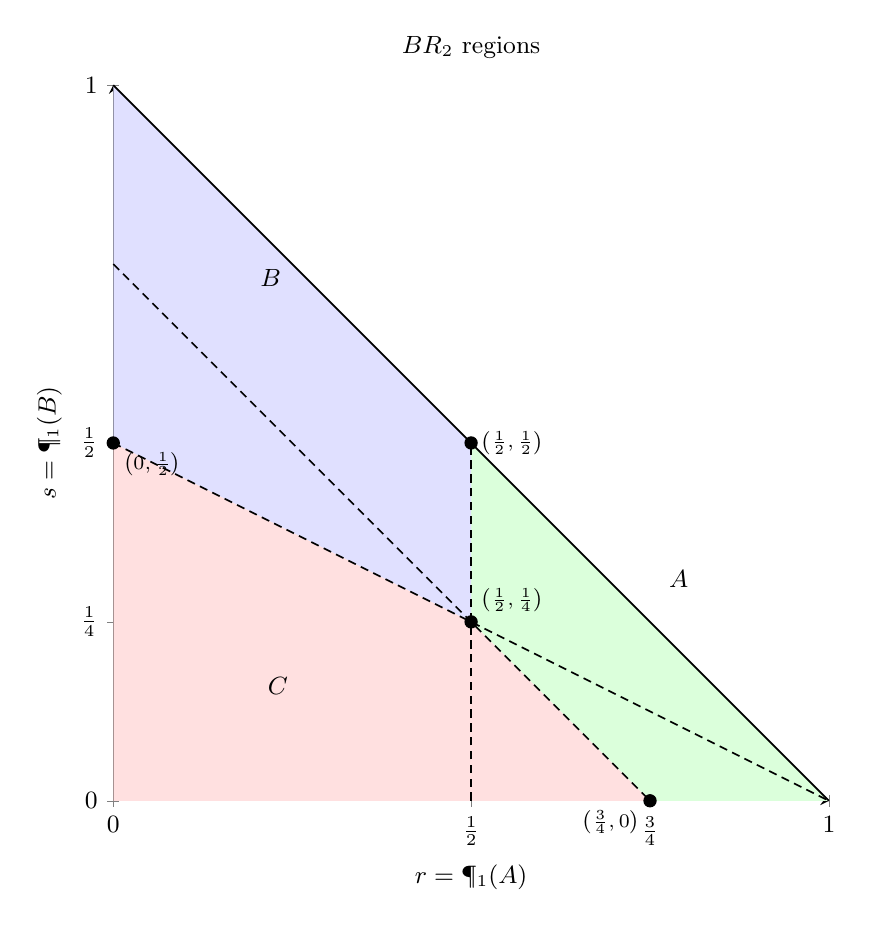
By symmetry, if Player 1 mixes with (r,s,1−r−s), then Player 2’s expected payoffs are:
E[π2(A)]=r+s,E[π2(B)]=1−r+s,E[π2(C)]=3−3r−3s.
Hence, for 0≤r≤1 and 0≤s≤1−r,
BR2(r,s)=⎩⎨⎧ABC{A,B}{A,C}{B,C}{A,B,C}if r>21 and r+s>43,if r<21 and r+2s>1,if r+s<43 and r+2s<1,if r=21,s>41,if r+s=43,r>21,if r+2s=1,r<21,if (r,s)=(21,41).
Diagram (Best Response Regions)
Each graph uses the first two probabilities on the axes. The probability on C is the residual term.
\centering
\centering
Derivation (Nash Equilibrium)
Pure mutual best responses give
(A,A),(B,B),(C,C).
For support {A,B}, set the probability on C equal to 0 and impose
p+q=1−p+q.
This gives
p=21.
Since q=1−p on this support,
p=21,q=21.
Check the omitted action:
E[π1(C)]=0<1.
For support {A,C}, set the probability on B equal to 0 and impose
p+q=3(1−p−q).
Since q=0 on this support, this gives
p=43,q=0,1−p−q=41.
Check the omitted action:
E[π1(B)]=1−43=41<43.
For support {B,C}, set the probability on A equal to 0 and impose
1−p+q=3(1−p−q).
Since p=0 on this support, this gives
q=21,1−p−q=21.
Check the omitted action:
E[π1(A)]=21<23.
For a fully mixed equilibrium, impose
p+q=1−p+q=3−3p−3q.
Solving gives
p=21,q=41,1−p−q=41.
By symmetry, Player 1 uses the same probability vector in each mixed equilibrium.