- Content map: SMU H3 Game Theory Map
Setup
Definition:
Investment Game with Moral Hazard
- Players: Player 1 is the Investor; Player 2 is the Friend.
- Strategies: Each period, the Investor chooses Invest or Safe; if investment occurs, the Friend chooses Repay or Abscond.
- Rules: The game repeats infinitely. Future payoffs are discounted by .
Payoff Details
- If the Investor invests , total output is .
- If the Friend repays , payoffs are .
- If the Friend absconds with , payoffs are .
- If the Investor chooses the safe outside option, payoffs are .
Game Tree
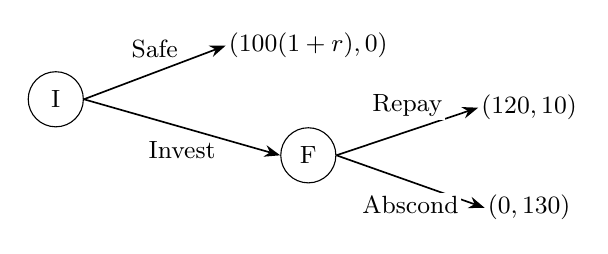
Derivation (Grim Trigger and One-Shot Deviations)
Grim trigger strategies
- Investor: invest in period and continue investing after histories with only Invest, Repay; after any deviation, choose Safe forever.
- Friend: repay after every investment as long as all previous investments were repaid; after any deviation, abscond if investment is ever offered.
- On the equilibrium path, play is Invest, Repay forever.
- After a deviation, the punishment path is Safe forever, giving payoffs each period.
Investor no-deviation condition
- If the Investor follows grim trigger, the continuation payoff is
- If the Investor deviates once to the safe outside option, grim trigger gives the safe payoff forever:
- No one-shot deviation requires
- Simplify the geometric sums:
- Since ,
- Divide by :
- Therefore,
Insight:
The Investor invests only if repayment beats the safe outside return. This constraint compares two permanent payoff streams, so patience cancels out.
Friend no-deviation condition
- If the Friend follows grim trigger, the continuation payoff is
- If the Friend deviates once by absconding, the Friend gets immediately and forever after:
- No one-shot deviation requires
- Simplify the geometric sums:
- Multiply by :
- Expand:
- Rearrange:
- Divide by :
- Substitute :
- Since , multiply both sides by :
- Expand:
- Rearrange:
- Therefore,
Insight:
The Friend repays only if the future stream of repayments is valuable enough to outweigh the immediate temptation to steal .
Punishment-state deviations
- In the punishment state, the Investor receives forever by choosing Safe.
- A one-shot investment during punishment gives at most immediately if the Friend absconds, so it is not profitable.
- The Friend receives when no investment occurs and has no profitable one-shot deviation on the punishment path.
Nash Equilibrium
Result:
By the one-shot deviation principle, grim trigger is a subgame perfect Nash equilibrium if
and
The binding constraint is the Friend’s no-deviation condition, since
Therefore the final equilibrium condition is
Social Optimum
- Perpetual investment and repayment generates total surplus each period.
- The safe outside option generates total surplus each period.
- Under the equilibrium condition , investment is socially efficient because .
Insights
Insight:
The investment relationship fails first because of the Friend’s moral hazard, not because of the Investor’s outside option. A higher interest rate lowers patience and makes the future relationship less able to discipline absconding.