- Content map: SMU H3 Game Theory Map
Setup
Definition:
First-Price Sealed-Bid Auction with Independent Private Values
- Players: bidders: bidder .
- Strategies: Each bidder observes own value ; Each bidder chooses a bid ; A symmetric bidding strategy is a function .
Rules
- Start with an object and privately known values ; Players simultaneously submit sealed bids .
- The player who submits the highest bid wins the object.
- Values are independently drawn from ; The highest bidder wins the object.
- The winner pays own bid.
- The winner’s payoff is ; Losing bidders receive payoff .
Game Tree
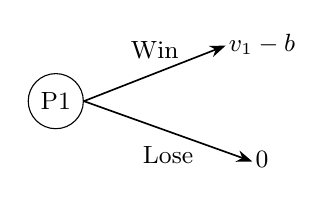
- Win means for every opponent when opponents use .
Derivation (Verification by Expected Payoff FOC)
Candidate strategy
- Claim that the symmetric Bayesian Nash equilibrium bidding function is
- Let
- Suppose all opponents use .
Deviation payoff
- Bidder has value and chooses a deviation bid .
- For , bidder wins when every opponent value satisfies
- Since opponent values are independent and uniform,
- Expected payoff from bid is
First-order condition
- Since is constant, maximize
- Differentiate:
- The interior maximizer solves
- For , ; For , . Hence is the best response on .
Verification
- If every opponent uses , bidder ‘s best response is
- The same argument applies to every bidder by symmetry.
- Therefore the candidate bidding function is a symmetric Bayesian Nash equilibrium.
Order-statistic intuition
- Let .
- Since there are opponents,
- Conditional on ,
Nash Equilibrium
Result:
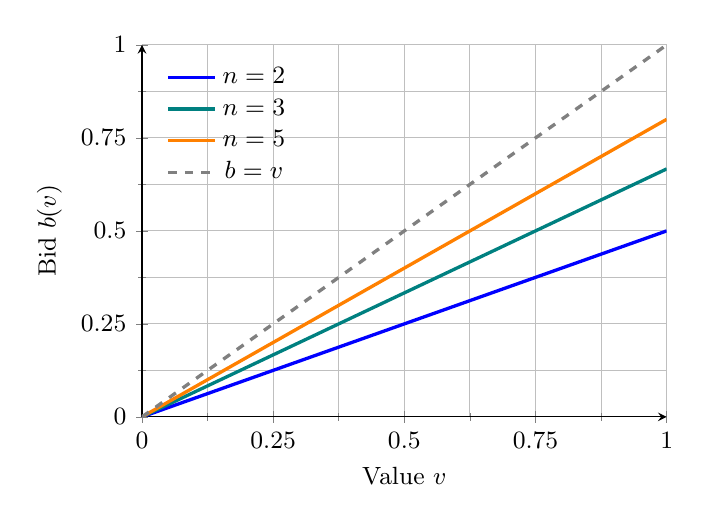
The symmetric Bayesian Nash equilibrium bidding function is
Social Optimum
- The object should go to the bidder with the highest value.
- Since is strictly increasing, the highest-value bidder also submits the highest bid.
- The equilibrium allocation is efficient.
Diagram (Bidding Function)
Insights
Insight:
- A bidder shades the bid below own value.
- The bid equals the expected strongest rival value conditional on winning.
- In a first-price auction, the trade-off is higher winning probability versus lower surplus if winning.