- Content map: SMU H3 Game Theory Map
Setup
Definition:
Coordination / Sequential Policy Game
- Players: Two players, Congress and Federal Reserve.
- Strategies: Congress: Budget Balance / Deficit; Fed: Low / High Interest Rates.
Rules
- Start with Congress and the Federal Reserve choosing fiscal and monetary policy.
- Players choose Budget Balance or Deficit and Low or High Interest Rates, either simultaneously or sequentially.
- The player who best responds to the policy environment maximises payoff.
- Either simultaneous or sequential depending on version
- In the sequential tree below, Congress and Federal Reserve
Game Tree
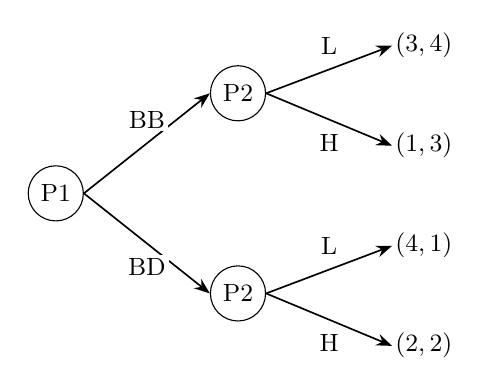
Payoff Matrix
| L | H | |
|---|---|---|
| BB | 3, 4 | 1, 3 |
| BD | 4, 1 | 2, 2 |
Derivation (Best Response Analysis)
- Congress:
- If LIR: prefers Deficit
- If HIR: prefers Deficit
- Fed:
- If BB: prefers LIR
- If BD: prefers HIR
Derivation (Nash Equilibrium)
- Mutual best responses occur at:
- (Deficit, High Interest Rate)
Nash Equilibrium
Result:
The unique equilibrium in the simultaneous version is
with payoff .
Social Optimum
Result:
The social optimum is
with payoff , since the sum of payoffs is maximised at .
Insights
Insight:
- Strategic interaction creates inefficiency
- Sequential play can improve outcomes because backward induction selects if Congress moves first