- Content map: SMU H3 Game Theory Map
Setup
Definition:
Sequential Entry Game
- Players: Two players, Player 1 (Entrant) and Player 2 (Incumbent).
- Strategies: Player 1: Invest / Don’t Invest; Player 2: High Price / Low Price (after entry).
Rules
- Start with an entrant deciding whether to enter a market.
- Players move sequentially: the entrant chooses Invest or Don’t Invest, then the incumbent chooses High Price or Low Price after entry.
- The player who chooses optimally at each reached subgame reaches the subgame-perfect outcome.
- Player 1 moves first
- Player 2 observes and responds
Game Tree
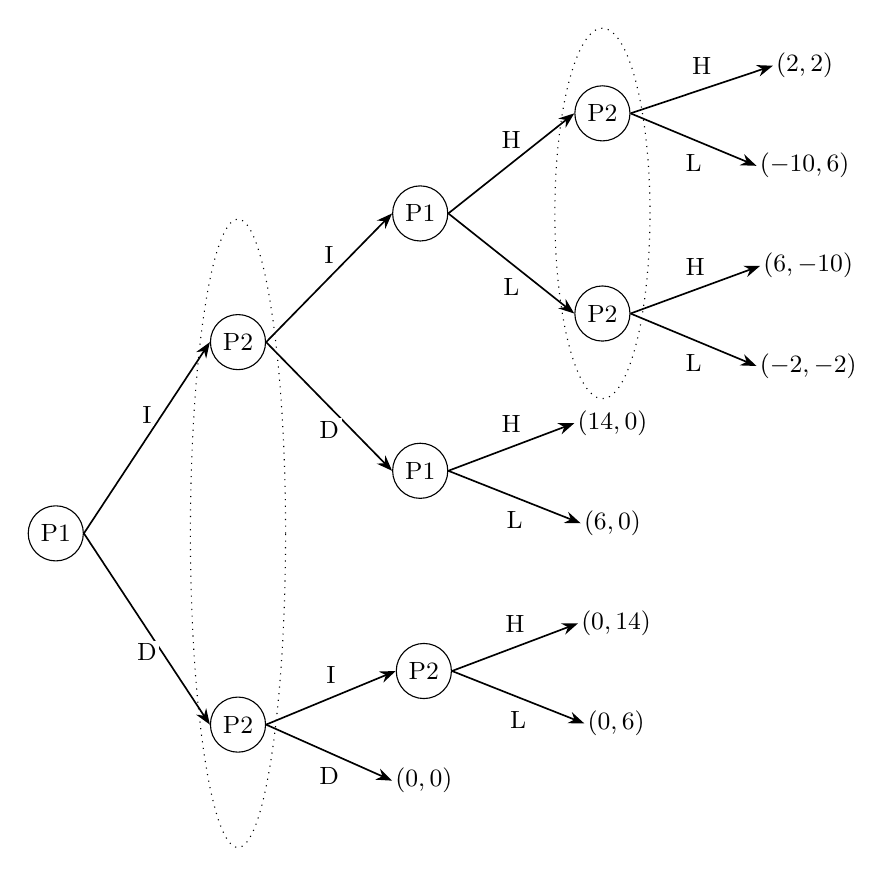
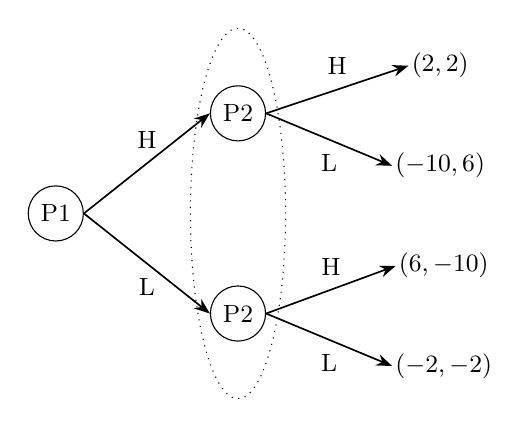
SG1: after (Invest,Invest)
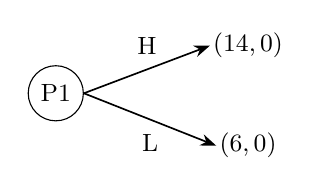
SG2: after (Invest,Don’t)
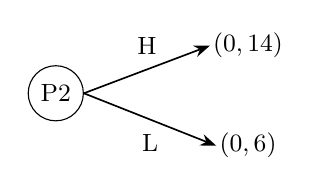
SG3: after (Don’t,Invest)
- Reduced first-stage payoffs:
Derivation (Best Response Analysis)
SG1
- P1
- If P2 chooses High, then Low gives .
- If P2 chooses Low, then Low gives .
- P2
- If P1 chooses High, then Low gives .
- If P1 chooses Low, then Low gives .
- Nash equilibrium: (Low,Low) with payoff .
SG2
- P1
- High gives .
- Low gives .
- Nash equilibrium / outcome: High with payoff .
SG3
- P2
- High gives .
- Low gives .
- Nash equilibrium / outcome: High with payoff .
Nash Equilibrium
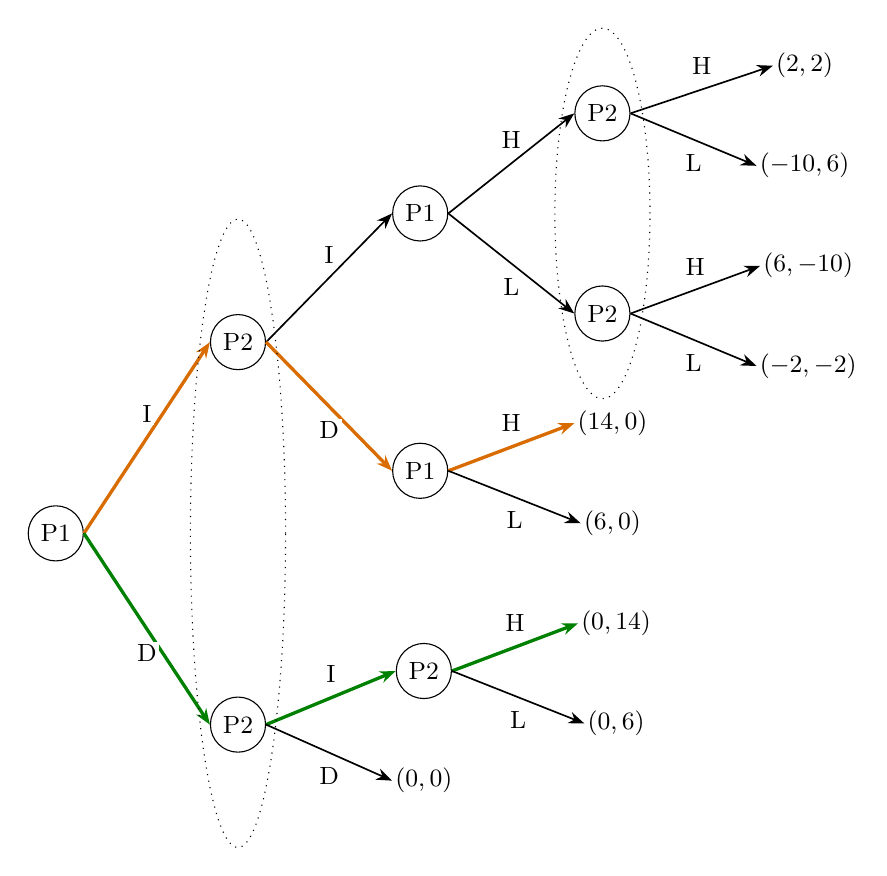
Orange highlights the SPNE path (Invest,Don’t,High).
Green highlights the SPNE path (Don’t,Invest,High).
Result:
SPNE strategy profiles:
- SPNE 1 with payoff
- SPNE 2 with payoff
Social Optimum
- Total payoff is at (Invest,Invest), at (Invest,Don’t), at (Don’t,Invest), and at (Don’t,Don’t).
- So the socially optimal outcomes are (Invest,Don’t) and (Don’t,Invest).
Insights
Insight:
- Solve the pricing subgames first, then replace them by continuation payoffs in the first-stage game.
- If both firms invest, simultaneous pricing drives both to Low price and payoff .
- The overall game has multiple SPNE because the reduced first-stage game has two asymmetric equilibria.