- Content map: SMU H3 Game Theory Map
Setup
Definition:
Sequential Entry-Deterrence Game
- Players: Entrant and Incumbent.
- Strategies: Entrant chooses Out or Enter; Incumbent chooses Accommodate or Fight after entry.
- Rules: Players move sequentially and optimal play is found by backward induction.
Game Tree
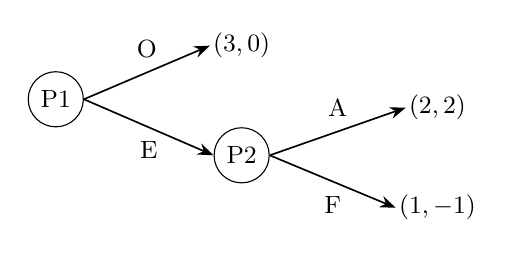
Payoff Details
- If Out: .
- If Enter and Accommodate: .
- If Enter and Fight: .
Derivation (Backward Induction)
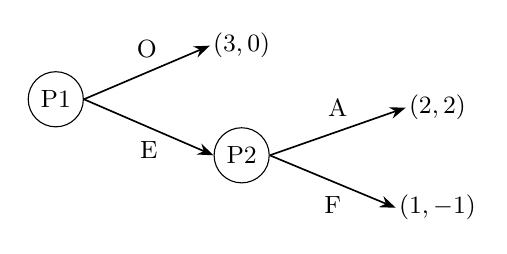
- If entry occurs, incumbent compares (accommodate) vs (fight), so chooses Accommodate.
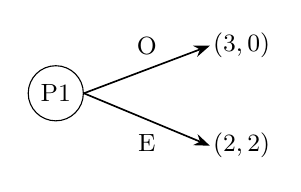
- Anticipating accommodation, entrant compares (enter) vs (out), so chooses Enter.
Nash Equilibrium
Result:
The subgame perfect Nash equilibrium strategy profile is:
The equilibrium outcome payoffs are .
Nash Equilibrium vs.\ SPNE
| Accommodate | Fight | |
|---|---|---|
| Enter | 2, 2 | -1, 1 |
| Out | 0, 3 | 0, 3 |
- The strategy profile {Out,Fight} is also a Nash equilibrium.
- Given Fight after entry, the entrant prefers Out because .
- Given Out, the incumbent’s action after entry is off the equilibrium path, so deviating from Fight to Accommodate does not change the realised payoff.
- Hence no player gains from a unilateral deviation at that strategy profile, so Nash equilibrium allows {Out,Fight}.
- But it is not subgame perfect because, in the subgame after Enter, the incumbent prefers Accommodate since .
Result:
The associated equilibria are:
- with a payoff of .
- with a payoff of .
Only {Enter,Accommodate} is SPNE.
Insights
Insight:
A threat to Fight may appear in a Nash equilibrium even when it is not credible.
SPNE removes such equilibria by requiring optimal play in every subgame, not just along the realised path.