- Content map: SMU H3 Game Theory Map
Setup
Definition:
Continuous contest game / Positional externality game
- Players: Candidate 1 and Candidate 2.
- Strategies: Candidate 1 chooses campaign spending ; Candidate 2 chooses campaign spending .
Rules
- Start with two candidates competing for a fixed prize.
- Players simultaneously choose non-negative campaign spending, and .
- The player who chooses the payoff-maximising spending level against the rival’s spending is optimal.
- If at least one candidate spends a positive amount, the prize is shared in proportion to spending.
- If both spend zero, each receives .
Payoff Details
- Payoffs are:
Derivation (Best Response Analysis)
Rule Out Zero Spending
- is not a Nash equilibrium because Candidate 1 can deviate to when and obtain
Candidate 1 Best Response
- For , Candidate 1 solves
- FOC for Candidate 1:
- Candidate 1’s interior best response is
- With the non-negativity constraint, for :
Candidate 2 Best Response
- By symmetry, for :
Solve the System
- At an interior Nash equilibrium, both FOCs hold:
- Hence .
- Substituting into either FOC gives
- For the positive solution:
- Therefore:
Diagram (Best Response Functions)
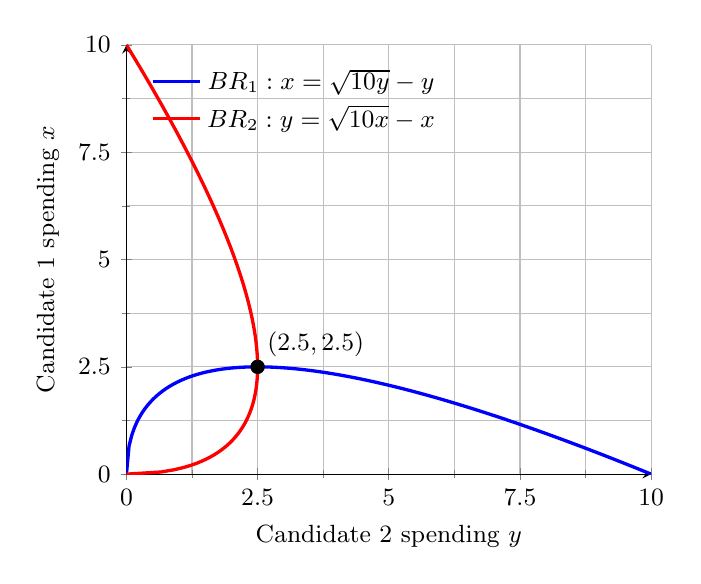
Nash Equilibrium
Result:
Each candidate receives .
Social Optimum
- Total payoff is
- Joint welfare is maximised at
Insights
Insight:
- Best responses are non-linear because each candidate’s marginal return depends on total spending.
- Nash equilibrium has positive spending by both candidates.
- The social optimum has zero spending, so equilibrium campaigning is wasteful rent-seeking.