SMU H3 Notes Game TheoryGamesSMU H3
Signalling Entry Game with Modified Low Cost
Game theory analysis: Signalling Entry Game with Modified Low Cost.
Setup
Definition:
Signalling Entry Game with Modified Low Cost
- Players: An incumbent firm (P1), and an entrant firm (P2).
- Strategies:
- Nature chooses the incumbent’s marginal cost mc1∈{10,15} with probabilities α and 1−α.
- The incumbent chooses p1∈{17.5,20}.
- The entrant observes the price and chooses In or Out.
- Rules:
- The incumbent has marginal cost 10 or 15 and fixed cost 0.
- The entrant has marginal cost 10 and fixed cost 40.
- If entry does not occur, the incumbent firm has the full market quantity.
p=25−q
- If entry occurs, firms play a Cournot duopoly.
p=25−(q1+q2)
Game Tree
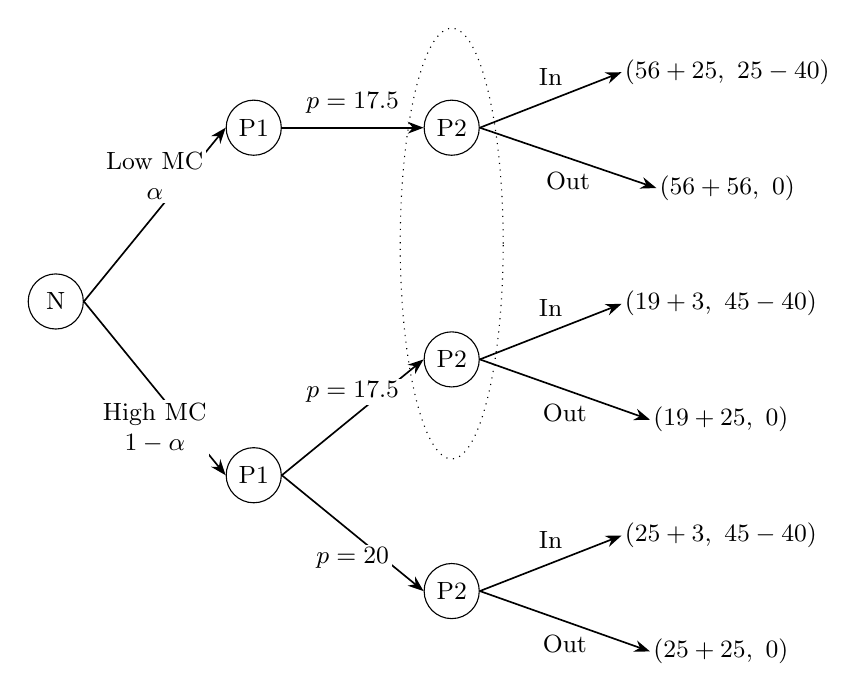
Payoff Details
Round 1
- Low-cost incumbent monopoly profit
π1=pQ−c1Q
π1=(25−Q)Q−10Q=(15−Q)Q
Q=7.5,p=17.5,π1=56.25≈56
- High-cost incumbent monopoly profit
π1=(p−c1)Q
π1=(17.5−15)(25−17.5)=18.75≈19
Using the notes’ rounded branch label:
π1≈19
π1=(25−Q)Q−15Q=(10−Q)Q
Q=5,p=20,π1=25
Round 2
- Considering the profits in a duopoly only.
- Low-cost incumbent duopoly profits
p=25−(q1+q2)
For P1 (incumbent):
π1=pq1−c1q1
π1=q1(25−q1−q2−c1)=q1(15−q1−q2)
Solving for FOC:
∂q1∂E(π1)=15−2q1−q2=0
q1=215−21q2
For P2 (entrant):
π2=pq2−mc2q2−fc2
π2=q2(25−q1−q2−mc2)−fc2=q2(15−q1−q2)−40
Solving for FOC:
∂q2∂E(π2)=15−q1−2q2=0
q2=215−21q1
Equating the two quantities:
q1=5,q2=5,p=15
π1=25,π2=25−40=−15
- High-cost incumbent duopoly profits
p=25−(q1+q2)
For P1 (incumbent):
π1=pq1−c1q1
π1=q1(25−q1−q2−c1)=q1(10−q1−q2)
Solving for FOC:
∂q1∂E(π1)=10−2q1−q2=0
q1=5−21q2
For P2 (entrant):
π2=pq2−mc2q2−fc2
π2=q2(25−q1−q2−mc2)−fc2=q2(15−q1−q2)−40
Solving for FOC:
∂q2∂E(π2)=15−q1−2q2=0
q2=215−21q1
Equating the two quantities:
q1=35≈2,q2=320≈7,p=350≈17
π1=925≈3,π2=940≈5
Derivation (Best Response Analysis)
Separating Equilibrium
- Candidate incumbent strategy:
(p(10),p(15))↦(17.5,20)
- Beliefs after observing price:
p=17.5⇒cI=10,p=20⇒cI=15
- Given these beliefs, the entrant compares net entry payoffs:
- After p=17.5: −15<0, so choose Out
- After p=20: 5>0, so choose In
- Hence the entrant strategy is
(x,y)↦(Out,In)
- High-cost incumbent deviation:
- Following the candidate signal p=20 induces In, giving 25+3=28.
- Deviating to p=17.5 would induce Out, giving 19+25=44.
- Since 44>28, the high-cost incumbent has a profitable deviation.
- Therefore the separating strategy is not an equilibrium.
Pooling Equilibrium
- Candidate incumbent strategy:
(p(10),p(15))=(17.5,17.5)
- If the entrant observes p=17.5:
- The entrant keeps the prior belief:
P(cI=10∣p=17.5)=α
- Expected payoff from In is
E(π2)In=α(25−40)+(1−α)(45−40)
=−15α+5(1−α)=5−20α
- So staying out after p=17.5 is optimal if
5−20α≤0⟺α≥41
BR2(α)={InOutif α<41if α≥41
-
If the entrant observes p=20:
- The entrant infers the high-cost incumbent.
- Since entry against the high-cost incumbent gives 5>0, the entrant chooses In.
-
The high-cost incumbent compares:
- Pooling at p=17.5 with no entry: 19+25=44
- Deviating to p=20, which induces entry: 25+3=28
-
Since 44>28, the high-cost incumbent does not deviate when the entrant stays out after p=17.5.
-
Therefore pooling exists when α≥41.
Semi-separating Equilibrium
-
Terms:
- α=P(cI=10) is the prior probability that the incumbent is low cost.
- q=P(p=17.5∣cI=15) is the probability that the high-cost incumbent mimics the low-cost type.
- μ=P(cI=10∣p=17.5) is the entrant’s posterior belief that the incumbent is low cost after seeing p=17.5.
- x=P(In∣p=17.5) is the probability that the entrant enters after seeing p=17.5.
-
Candidate semi-separating strategy:
- The low-cost incumbent chooses p=17.5 for sure.
- The high-cost incumbent chooses p=17.5 with probability q and p=20 with probability 1−q.
- For genuine semi-separating, q∈(0,1).
-
If p=20 is observed, the entrant knows the incumbent is high cost, because only the high-cost type chooses p=20 in the candidate strategy.
-
Since entry against the high-cost incumbent gives 45−40=5>0, the entrant chooses In after p=20.
-
If p=17.5 is observed, the entrant updates its belief by Bayes’ rule:
μ=P(cI=10∣p=17.5)=α+q(1−α)α
- The numerator is the probability that the incumbent is low cost and chooses p=17.5:
P(p=17.5∣cI=10)P(cI=10)=1⋅α
- The denominator is the total probability of observing p=17.5:
P(p=17.5)=1⋅α+q(1−α)
μ=1⋅α+q(1−α)1⋅α=α+q(1−α)α
- Entrant indifference pins down μ:
- If the entrant enters after p=17.5, expected payoff is
E(π2)In=μ(25−40)+(1−μ)(45−40)
- If the entrant stays out, payoff is 0.
- The entrant mixes only if it is indifferent:
μ(25−40)+(1−μ)(45−40)=0
−15μ+5(1−μ)=0⟺μ=41
- Belief indifference pins down q:
Substitute μ=41 into Bayes’ rule:
α+q(1−α)α=41
so
4α=α+q(1−α)
q=1−α3α
- Since genuine semi-separating requires q∈(0,1):
1−α3α<1⟺α<41
- High-cost incumbent indifference pins down x:
- If the high-cost incumbent chooses p=20, the entrant enters, giving
25+3=28
- If the high-cost incumbent chooses p=17.5, the entrant enters with probability x and stays out with probability 1−x, giving
x(19+3)+(1−x)(19+25)
- The high-cost incumbent mixes only if it is indifferent:
28=x(19+3)+(1−x)(19+25)
28=22x+44(1−x)
x=118
Nash Equilibrium
Result:
A pooling equilibrium exists when α≥41 and is given by
{cI=10,cI=15}↦{p=17.5,p=17.5}
{p=17.5,p=20}↦{Out,In}
A semi-separating equilibrium exists when α<41 and is given by
cI=10↦p=17.5
cI=15↦{p=17.5p=20with probability qwith probability 1−qwhere q=1−α3α
p=17.5↦{InOutwith prob xwith prob 1−xwhere x=118,
p=20↦In
- Posterior beliefs of the entrant are:
P(cI=10∣p)={41,0,if p=17.5if p=20
Social Optimum
- Entry is inefficient when the incumbent is low cost because the entrant’s net payoff is negative:
25−40=−15<0
- Entry is efficient when the incumbent is high cost because the entrant’s net payoff is positive:
45−40=5>0
- Pooling hides the incumbent’s type at p=17.5.
- Semi-separating reveals partial information and makes the entrant mix after the pooled signal.
Insights
Insight:
- Raising the low-cost type from 5 to 10 changes the equilibrium set: pooling and semi-separating can now exist.
- Pooling works when the prior probability of the low-cost incumbent is large enough to make entry unattractive after p=17.5.
- Semi-separating requires two indifference conditions:
- The entrant must be indifferent after p=17.5.
- The high-cost incumbent must be indifferent between p=17.5 and p=20.
- The posterior belief μ=41 is pinned down by the entrant’s indifference condition.