- Content map: SMU H3 Game Theory Map
Setup
Definition:
Continuous competition game
- Players: Two players, Coke and Pepsi.
- Strategies: Coke chooses price ; Pepsi chooses price .
Rules
- Start with Coke and Pepsi facing linear demands; Players simultaneously choose prices and .
- The player who chooses a profit-maximising price against the rival’s price is optimal.
- Demand for Coke: ; Demand for Pepsi: .
- Marginal cost is for each firm
- Profit equals total revenue minus total cost
Derivation (Best Response Analysis)
Coke payoff function
- Coke’s profit is
Illustration with fixed rival prices
- If , then
so the first-order condition is
and the best response is .
- If , then
so the best response is .
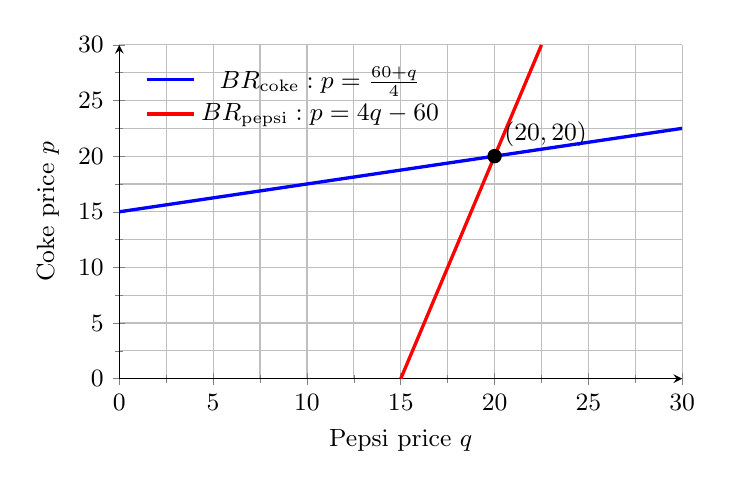
Coke best response
- In general,
- Setting the first-order condition equal to zero gives Coke’s best response:
Pepsi best response
- Pepsi’s profit is
- Pepsi’s first-order condition is
- Setting the first-order condition equal to zero gives Pepsi’s best response:
Diagram (Best Response Functions)
Derivation (Nash Equilibrium)
Solve best-response system
- Solve the system
Rearrange
- Rearranging gives
Equilibrium prices
- Solving the two equations yields
Nash Equilibrium
Result:
The Nash equilibrium is
Payoffs at the Nash Equilibrium
- Coke’s profit is
- Pepsi’s profit is
Collusive Benchmark
- If both firms maximise joint profit, they solve
- The first-order conditions are
- Solving gives
- Each firm’s collusive profit is
Incentive to Deviate
- If Pepsi keeps , Coke’s one-shot best response is
- Coke then earns
- Since , unilateral deviation beats the collusive payoff.
Insights
Insight:
- Individual optimisation gives lower prices than joint-profit maximisation.
- Collusion raises profits but is unstable in a one-shot game.
- Best-response analysis and first-order conditions recover the equilibrium cleanly.