- Content map: SMU H3 Game Theory Map
Setup
Definition:
Incomplete-Information Ultimatum Game
- Players: Three players, Sender, Receiver, and Nature, who selects the receiver’s type.
- Strategies: Sender chooses whether to offer or from a pie of size ; Rational receiver accepts any non-negative offer; Crazy receiver accepts only offers of at least .
Rules
- Start with Nature selecting the receiver’s type with probability ; Players move sequentially: the sender offers or , then the receiver accepts or rejects.
- The player who chooses optimally given beliefs maximises expected payoff.
- With probability , the receiver is crazy.
- With probability , the receiver is rational; The sender does not observe the receiver’s type.
- Payoffs are ordered as (Sender, Receiver).
Game Tree
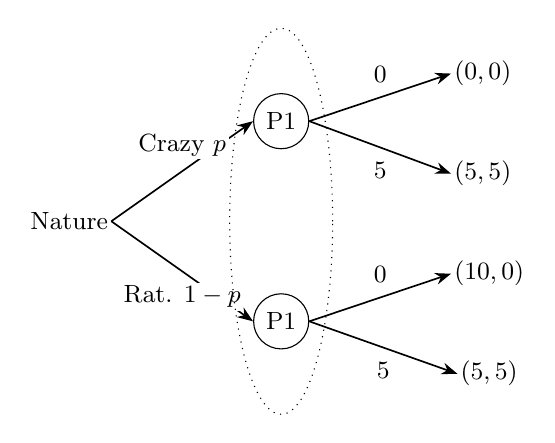
Derivation (Best Response Analysis)
- If Sender offers , only the rational receiver accepts.
- Sender’s expected payoff from offering is:
- If Sender offers , all receivers accept.
- Sender’s expected payoff from offering is:
Derivation (Nash Equilibrium)
- Offering is optimal when:
- Therefore:
- If , the sender offers .
- If , the sender offers .
- If , the sender is indifferent.
Nash Equilibrium
Result:
Offering is a Perfect Bayesian Equilibrium strategy if and only if:
Insights
Insight:
- A reputation for irrational toughness can shift bargaining power.
- The receiver benefits when the sender assigns enough probability to the crazy type.
- Generating sufficient doubt about rationality can be a strategic move.