- Content map: SMU H3 Game Theory Map
Setup
Definition:
Sequential Centipede Game
- Players: Player 1 and Player 2.
- Strategies: Player 1 acts at nodes and , so a pure strategy specifies one action at each node; Player 2 acts at nodes and , so a pure strategy specifies one action at each node.
- Rules:
- Start at the first decision node with a growing surplus path.
- Players alternate choosing Stop or Continue.
- The player who stops ends the game at the current terminal payoff.
Game Tree
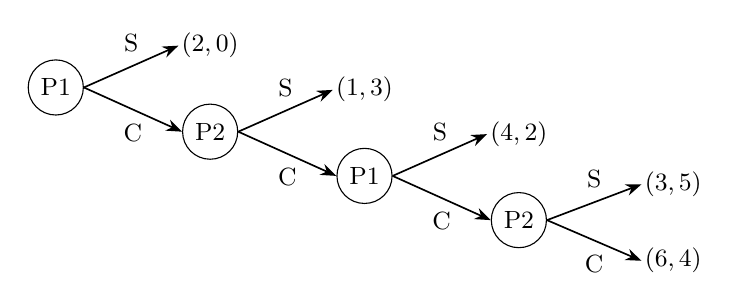
Payoff Details
- In the tree, and .
- Let the decision nodes be:
- Terminal payoffs if the mover stops:
- Stop at 1:
- Stop at 2:
- Stop at 3:
- Stop at 4:
- If P2 continues at 4 (i.e. the game reaches the end), payoffs are .
Derivation (Backward Induction)
- At node N4 (P2): compare Stop vs Continue . P2 prefers Stop since .
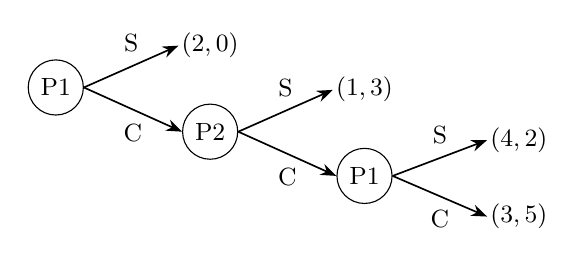
- At node N3 (P1): if Continue, P2 stops at 4 P1 gets ; stopping now gives . Hence P1 stops at 3.
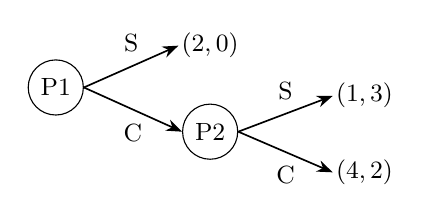
- At node N2 (P2): if Continue, P1 stops at 3 P2 gets ; stopping now gives . Hence P2 stops at 2.
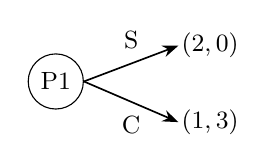
- At node N1 (P1): if Continue, P2 stops at 2 P1 gets ; stopping now gives . Hence P1 stops immediately.
Nash Equilibrium
Result:
The unique subgame perfect Nash equilibrium strategy profile is:
Hence, Player 1 stops at the first move and the game ends.
Insights
Insight:
Backward induction can predict early termination even when mutual continuation would increase total surplus.