- Content map: SMU H3 Game Theory Map
Setup
Definition:
All-Pay Auction with Common Known Value
- Players: bidders, where .
- Strategies: Each bidder chooses a bid ; In the symmetric mixed-strategy equilibrium, each bidder draws from the same distribution .
Rules
- Start with a common-value prize; Players simultaneously choose non-negative bids and pay their bids regardless of outcome.
- The player who submits the highest bid wins the prize.
- The prize value is ; Every bid is paid.
- Only the highest bidder receives the prize.
- With a continuous mixed strategy, ties occur with probability .
Derivation (Verification by Expected Payoff FOC)
Candidate distribution
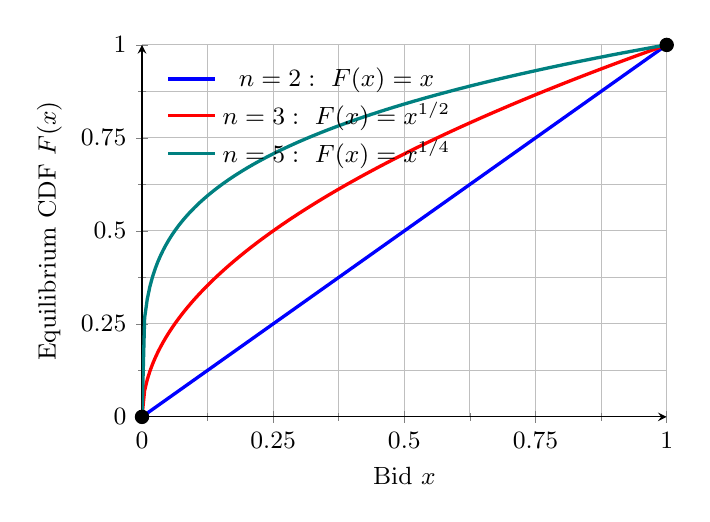
- Claim that the symmetric mixed-strategy equilibrium CDF is
- Let be the probability that one opponent’s bid is at most .
- If bidder bids , bidder wins when all opponents bid at most .
- Independent mixing gives
- Expected payoff is
- Substituting the candidate:
- Thus every bid in gives the same expected payoff.
First-order condition
- Since expected payoff is constant on the support,
- Equivalently,
- Hence
- The candidate satisfies this FOC.
Support
- At the lower endpoint, , so
- Since a bidder can always bid and get payoff at least , the lower endpoint must be
- Therefore .
- The indifference condition becomes
- Hence
- At the upper endpoint, , so
- Thus
Nash Equilibrium
Result:
The symmetric mixed-strategy equilibrium has support and cumulative distribution function
Social Optimum
- Because the prize has common known value, every bidder values winning at .
- Equilibrium expected payoff is for each bidder.
- Expected payment by each bidder is
- Total expected payments are therefore .
Diagram (Best Response Functions)
Insights
Insight:
- All bidders pay regardless of whether they win.
- Mixing makes every bid in give the same expected payoff.
- Competition dissipates the full prize value in expectation.
- Any bid above wins for sure but gives negative payoff.