- Content map: SMU H3 Game Theory Map
Chapter 9: Uncertainty and Information
Games of Incomplete Information
Nature and Information
Definition:
Nature selects game ingredients at random and non-strategically.
Players have common knowledge of the game structure but observe only some of Nature’s moves, creating imperfect information.
Strategies and Beliefs
- Strategies depend on information about Nature’s move.
Result:
The equilibrium concept stays the same, but players must form beliefs about other players’ information, and these beliefs must be consistent with observed actions whenever possible.
Insight:
Behaviour reveals information because actions depend on information.
Uncertainty and Incomplete Information
Concept
- Some uncertainty is external to the players and cannot be controlled directly.
- Strategic interaction becomes richer when players hold different information about that uncertainty.
Definition
Definition:
A game of incomplete information is a game in which at least one player is uncertain about a payoff-relevant characteristic, such as types, values, or costs.
External Uncertainty
Definition:
External uncertainty is payoff-relevant uncertainty caused by events outside the decision maker’s control.
Method / Reasoning
- Identify what is uncertain.
- Identify who knows that information.
- Track how actions and messages reveal information.
Implications
- Actions can serve both as choices and as signals.
- Equilibrium depends on beliefs as well as actions.
Result:
Incomplete information requires analysing strategies and belief updating together.
Insight:
The key question is not only what players want to do, but also what others infer from what they do.
Risk Aversion, Risk Sharing, and Insurance
Concept
- External uncertainty comes from random events beyond the control of a single decision maker.
- The decision maker takes those events as given and chooses an action to maximise expected payoff.
Risk Aversion
Definition:
A risk-averse agent prefers less uncertainty when the average payoff is unchanged.
With Bernoulli utility , risk aversion is represented by an increasing and concave utility function:
For any risky payoff ,
- The agent may prefer a certain payoff to a risky payoff with the same expected monetary value.
- Example: if and with equal probabilities, then
- The certainty equivalent is because .
- The risk premium is .
Diagram (Bernoulli Utility)
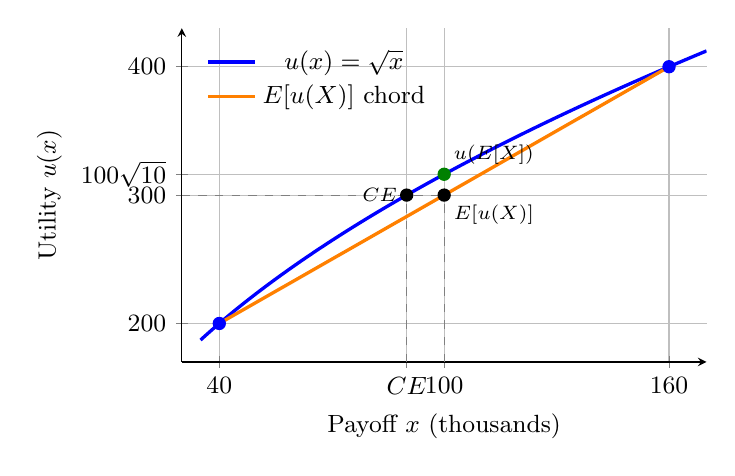
Insight:
The stronger the dislike of uncertainty, the more the agent values protection against bad states.
Risk Sharing
Insight:
Risk sharing converts state-dependent payoffs into a more predictable payoff stream.
- Risk sharing is useful when outcomes move in opposite directions across agents.
- If one agent has a good outcome when another has a bad outcome, transfers can smooth both agents’ payoffs.
- A sharing agreement makes the lucky agent compensate the unlucky agent.
- The aim is a more stable outcome without changing the average payoff.
Insurance
- Insurance is a risk-sharing arrangement.
- The insured agent gives up some payoff in good states to receive protection in bad states.
- Insurance is valuable because it reallocates payoffs across states.
Result:
Insurance does not create extra average income; it changes who bears risk and when.
Cheap Talk
Concept
- Communication can affect equilibrium even when messages are costless and non-binding.
- Whether it works depends on how aligned players’ interests are.
Definition
Definition:
Cheap talk is costless pre-play communication that does not directly change payoffs or feasible actions.
Method / Reasoning
- Add a communication stage before the underlying game.
- Check what happens if players believe and follow the message.
- Check what happens if players ignore the message.
- See which outcome each player prefers.
Implications
- Cheap talk can coordinate players in common-interest environments.
- Cheap talk fails in zero-sum settings because messages are not credible.
- Bubbling equilibria remain possible: communication may be ignored in equilibrium.
Result:
Cheap talk is informative only when incentives are aligned enough for truthful communication to be optimal.
Insight:
Words matter in games only when the incentives behind the words make them believable.
Adverse Selection
Concept
- Private information on quality can destroy trade.
- Acceptance or refusal of an offer reveals information to the other side.
Definition
Definition:
Adverse selection is a market failure caused by hidden information, where the uninformed side cannot distinguish high-quality from low-quality types before trade.
Method / Reasoning
- Ask which types accept any given offer.
- Update beliefs after acceptance.
- Check whether the uninformed side still wants to trade at that price.
Implications
- Trade may unravel even when mutually beneficial exchanges exist under full information.
- Low-quality types remain, while high-quality types exit.
Result:
Markets with hidden information can collapse because the act of accepting an offer changes what the offer means.
Insight:
Selection effects matter because prices influence who stays in the market.
Signalling and Incentive Compatibility
Concept
- Informed players may take costly actions to reveal their type.
- A type is a player’s private payoff-relevant characteristic (i.e. a characteristic that affects the payoff).
Definition
Definition:
A signalling equilibrium commonly has three possible patterns:
- Separating when different types choose different actions.
- Pooling when different types choose the same action.
- Semi-separating when at least one type randomises, so actions reveal partial but not perfect information.
Incentive compatibility ensures each type prefers the action intended for that type.
Result:
A signal works only if low types do not want to imitate high types.
Incentive Compatibility Inequalities
- Let and denote the high and low types.
- Let denote the payoff of a player with true type but sends signal .
Separating Equilibrium
Definition:
For a separating equilibrium where sends and sends , incentive compatibility requires:
Each type must prefer its own signal to imitating the other type.
Pooling Equilibrium
Definition:
For a pooling equilibrium on signal , incentive compatibility requires:
Both types must prefer sending the high-type signal.
Definition:
For a pooling equilibrium on signal , incentive compatibility requires:
Both types must prefer sending the low-type signal.
Semi-Separating Equilibrium
Definition:
For a semi-separating equilibrium, at least one type mixes between signals.
If type mixes between signals and , incentive compatibility requires indifference:
If type uses a pure signal, incentive compatibility requires weak preference for that signal.
- Let be the probability that type sends signal .
- Let be the probability that type sends signal .
- Receiver beliefs follow Bayes’ rule whenever a signal is observed with positive probability.
- Signals are partially informative when but neither signal perfectly identifies type.
Insight:
Semi-separating equilibrium is between pooling and separating: the signal changes beliefs, but it does not fully reveal the sender’s type.
Worked Example: Finding a Semi-Separating Equilibrium
Definition:
Nature draws the sender’s type:
- Sender chooses or ; receiver observes the signal, then Accepts or Rejects.
- Receiver payoff from Accept is against and against ; Reject gives .
- Accepted sender gross payoff is for and for .
- Signal cost is , for , and for .
- Sender payoff is gross payoff minus signal cost; Reject gives gross payoff .
Game Tree
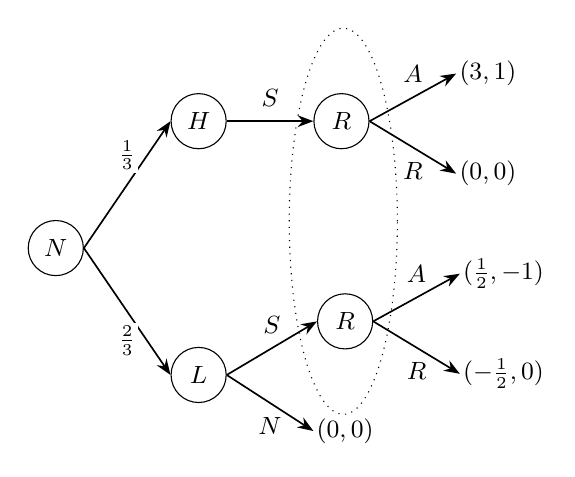
Look for a semi-separating equilibrium where:
- always sends .
- sends with probability and with probability .
- The receiver accepts after with probability ; is shown as the direct rejection payoff.
Step 1: Find the posterior after signal
- By Bayes’ rule,
- Since and ,
- The signal is partially informative: observing raises the probability of above the prior, but does not identify the type perfectly when .
Step 2: Impose receiver indifference
- The receiver mixes after only if Accept and Reject give the same expected payoff.
- Reject gives .
- Accept gives
- Indifference requires
- Using the posterior formula,
Why impose receiver indifference?
- In a mixed strategy, every action used with positive probability must be optimal.
- If Accept were strictly better, the receiver would accept with probability .
- If Reject were strictly better, the receiver would reject with probability .
- Therefore, for the receiver to mix after , the sender’s mixing probability must make the receiver indifferent.
Step 3: Impose low-type sender indifference
-
Type mixes between and , so both must give the same expected payoff.
-
If sends , the receiver rejects, so
- If sends , the receiver accepts with probability .
- The signalling cost is paid whenever is sent, so
- Indifference requires
Why impose sender indifference?
- Type sends both and with positive probability.
- If gave strictly more than , type would always send .
- If gave strictly more than , type would never send .
- Therefore, the receiver’s acceptance probability must make type indifferent.
Step 4: Check the pure actions
- Type prefers to because gives , while gives .
- After , the receiver knows the sender is , so Accept gives and Reject gives .
- Therefore, rejecting after is optimal.
Result:
In this semi-separating equilibrium:
- **Sender: **
- **Receiver: **
- The posterior after observing is
- The signal is informative but imperfect because both types can send , while only sends .
Method / Reasoning
- Write each type’s payoff from signalling and from not signalling.
- Impose incentive compatibility inequalities.
- For any mixing type, impose equality between the signals used with positive probability.
- Impose individual rationality inequalities when relevant.
Implications
- Productive-looking actions may be chosen partly because they reveal hidden ability.
Insight:
Signals can be socially wasteful even when privately optimal. Credibility comes from the difference in cost, not from the message itself.
Screening and Self-Selection
Concept
- Screening reverses the information problem.
- The uninformed side designs options to learn information that is relevant to them.
Definition
Definition:
Screening is a mechanism in which process where an uninformed player (principal) acts first to compel an informed player (agent) to reveal private information.
Method / Reasoning
- Specify each type’s willingness to pay for each option.
- Choose product attributes or contract terms that types value differently.
- Choose prices to satisfy incentive compatibility and participation.
- Leave just enough surplus for each type to choose the intended option.
- Compare menu revenue with uniform-pricing revenue.
Menu Design Logic
Definition:
A menu is incentive compatible when every type weakly prefers its assigned option to all other options in the menu.
For types and with assigned options and :
- Menu design is the standard tool: offer several contracts, versions, or price-quality bundles.
- Each option must be attractive to its target type and unattractive to the wrong type.
- The menu uses self-selection instead of direct identification.
Implications
- Firms can increase revenue by offering differentiated versions of the same product.
- Successful screening requires each type to prefer its designated option.
Result:
Price discrimination through screening can dominate uniform pricing when types value product attributes differently.
Insight:
The menu’s purpose is to sort types using their own incentives.