- Content map: SMU H3 Game Theory Map
Chapter 3: Sequential Moves Games
Sequential Games
Definition:
A sequential game is a game in which players move in turn, so later players can condition their actions on earlier observed moves.
- Order matters because current choices affect later responses.
- The benchmark case is perfect information: each player observes the previous moves before acting.
- Some sequential games relax this information assumption, but rollback logic starts from the perfect-information case.
Insight:
Sequential structure changes the problem from “what action should I choose now?” to “what will happen after each possible move?”
Game Trees (Extensive Form)
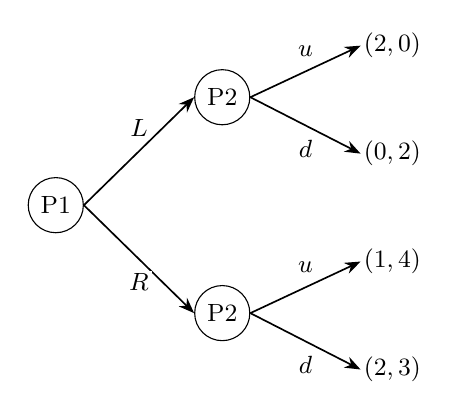
Definition:
Sequential games are represented in extensive form. A strategy is a complete contingent plan that specifies what a player does at every decision node they may reach.
- The game tree records decision nodes, feasible actions, histories, and terminal payoffs.
- The realised path is only one branch of the tree; the strategy must specify choices even at nodes that are not reached.
- This is why a player may have many more pure strategies than observed actions.
- If a player has two decision nodes with two actions at each node, they have pure strategies.
Insight:
In sequential games, an action is local to one node; a strategy covers the whole tree.
Backward Induction
Definition:
Backward induction solves a finite sequential game by solving the last decision first and then repeatedly working back to the initial node.
- Look ahead and think back.
- At each final node, identify the optimal action for the player moving there.
- Replace that continuation by its implied payoff.
- Repeat until the first move is solved.
Result:
Backward induction gives the benchmark prediction for finite sequential games with perfect information.
Rollback Equilibrium
Definition:
The rollback equilibrium is the strategy profile generated by applying backward induction to the whole tree.
- It consists of one complete strategy for each player, not just the realised outcome.
- Each player’s action must be optimal whenever their decision node is reached.
- If a player is indifferent at some node, more than one rollback equilibrium may arise.
Insight:
Rollback equilibrium is stricter than describing the path of play: it also specifies what would happen after histories that do not occur in equilibrium.
Credibility
Definition:
A threat or promise is credible only if carrying it out is optimal when the relevant node is actually reached.
- In sequential games, players care about future actions only if those actions will still be optimal later.
- Backward induction removes empty (non-credible) threats because off-path announcements are ignored once the future node is reached.
- Strategic commitment matters only when it can change what will actually happen at that later node.
Insight:
Sequential analysis separates what a player says now from what they will want to do later.
Interpreting Deviations from the Benchmark
Definition:
When observed behaviour differs from rollback predictions, the standard response is to reconsider the payoff function rather than abandon strategic reasoning.
- Money may not be the only argument in payoffs.
- Fairness, anger, reciprocity, reputation, or other motives can change best responses.
- Laboratory evidence shows that people often reject unfair offers, especially when the opponent is another person rather than a machine.
Insight:
If the benchmark prediction fails, the first question is usually not “is game theory wrong?” but “what payoff element is missing?”