Syllabus Map
- Study map: Syllabus Study Map
Core Definition
For square matrix , an eigenvector and eigenvalue satisfy:
- acts on by scaling (and possibly sign flip), not changing its direction.
How to Compute Eigenvalues
Step 1: Characteristic Equation
Solve:
This polynomial is the characteristic polynomial.
Step 2: Find Eigenvectors
For each eigenvalue , solve:
to get non-zero vectors in that null space.
2x2 Example
Let
Characteristic equation:
So eigenvalues are , .
Corresponding eigenvectors (up to scaling):
- For :
- For :
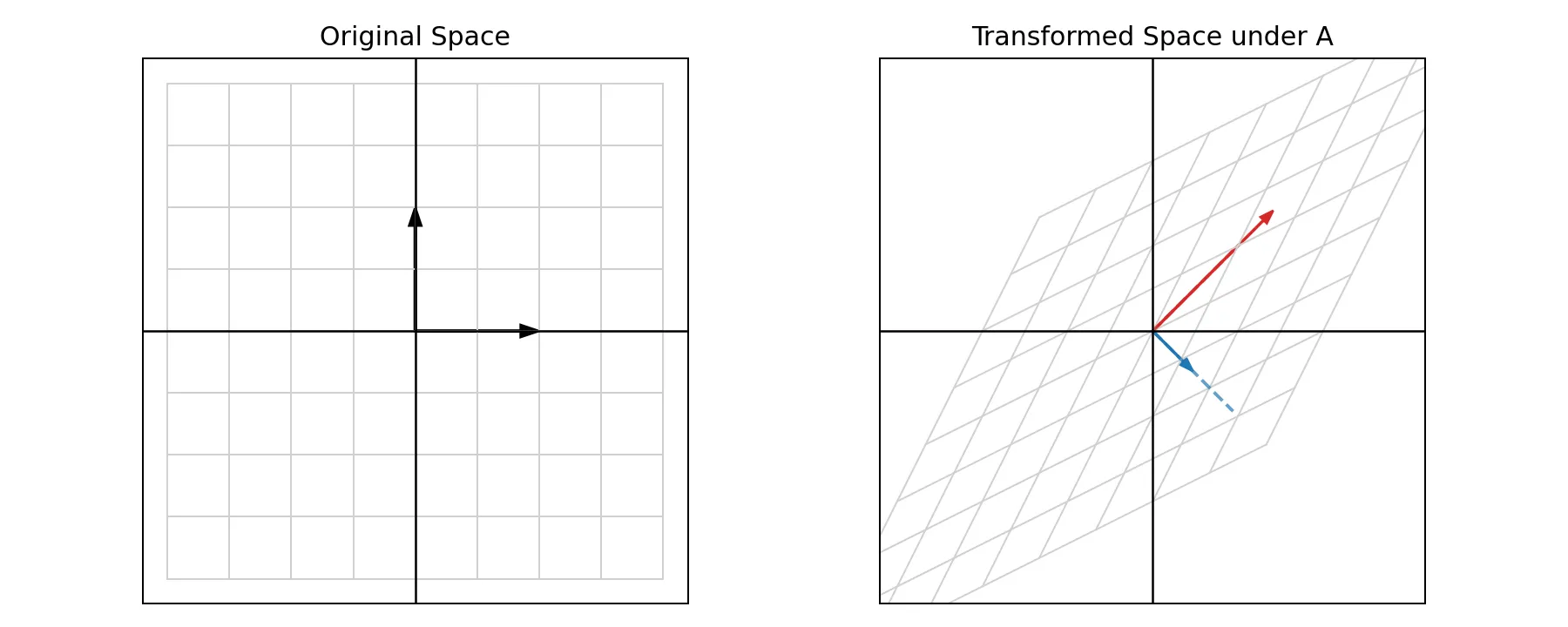
Geometric Intuition
- Most vectors are rotated/sheared/scaled by .
- Eigenvectors are special directions that remain on the same line.
- Eigenvalues tell how much stretching/compression occurs along those directions.
Diagonalisation
If has enough independent eigenvectors, then:
where:
- Columns of are eigenvectors
- is diagonal with eigenvalues
Then powers are easy:
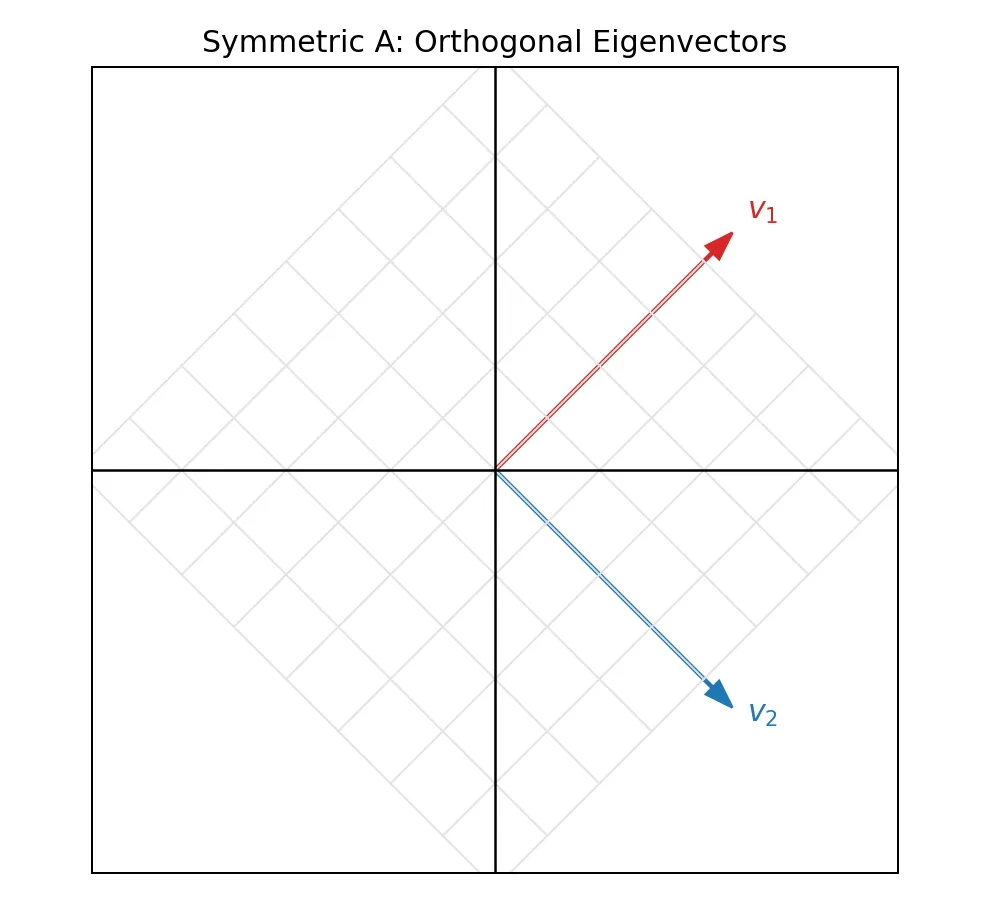
Symmetric Matrices (Very Important)
If :
- All eigenvalues are real
- Eigenvectors for distinct eigenvalues are orthogonal
- Decomposition becomes:
with orthonormal .
This is the basis of PCA and many optimisation results.
Connection to SVD
For any matrix :
- Columns of are eigenvectors of
- Columns of are eigenvectors of
- Singular values satisfy:
Why This Matters for ML
- PCA, spectral clustering, and graph-based methods depend on eigenvectors/eigenvalues.
- Eigenvalues indicate variance/energy concentration and stability properties of transformations.
- Iterative optimization and dynamical behavior are often explained by spectral radius and modes.
- Symmetric eigendecompositions are foundational in covariance analysis and many kernels.