Syllabus Map
- Study map: Syllabus Study Map
Core Idea
- Determinant describes signed area/volume scaling of a linear map.
- Invertibility means a unique reverse mapping exists.
What Determinant Means
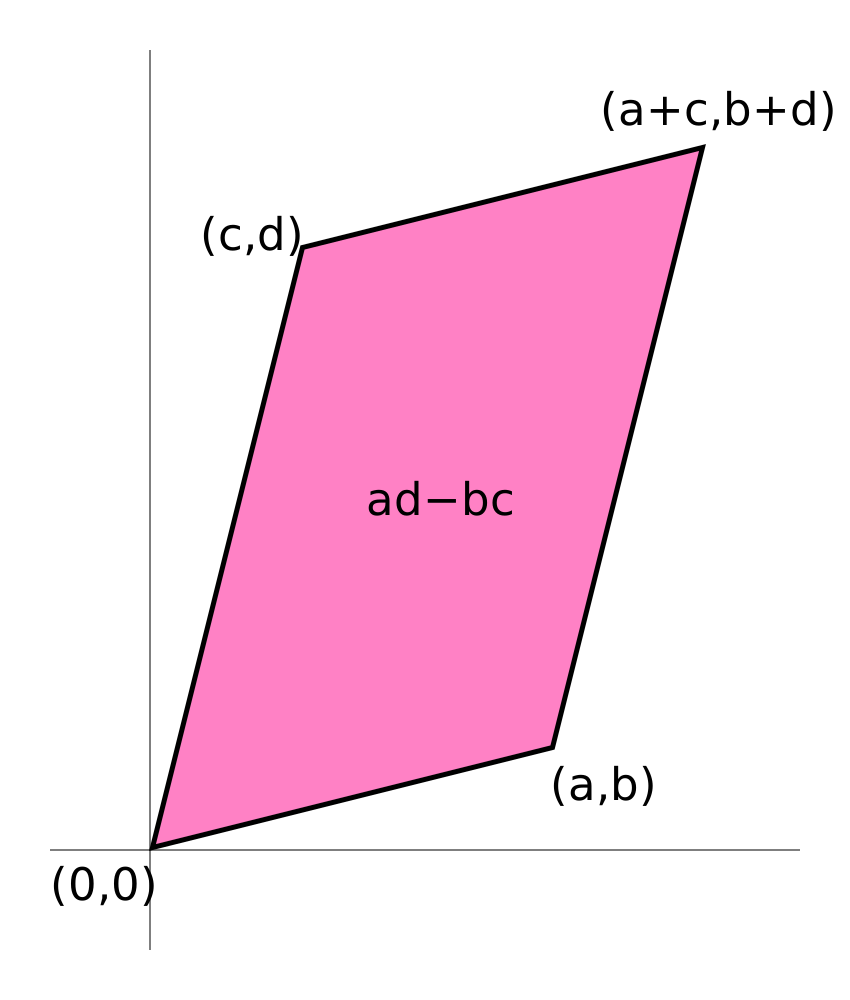
- Think of a matrix as a transformation of space.
- tells how much scales area (in 2D) or volume (in 3D).
- means areas/volumes become 3 times larger.
- means they shrink to one-fifth.
- The sign of tells orientation:
- : orientation preserved.
- : orientation flipped (reflection involved).
- means at least one dimension is collapsed, so information is lost.
- Geometric picture:
- In 2D, maps the unit square to a parallelogram.
- In 3D, maps the unit cube to a parallelepiped.
- The area/volume of that transformed shape is exactly .
What Invertibility Means
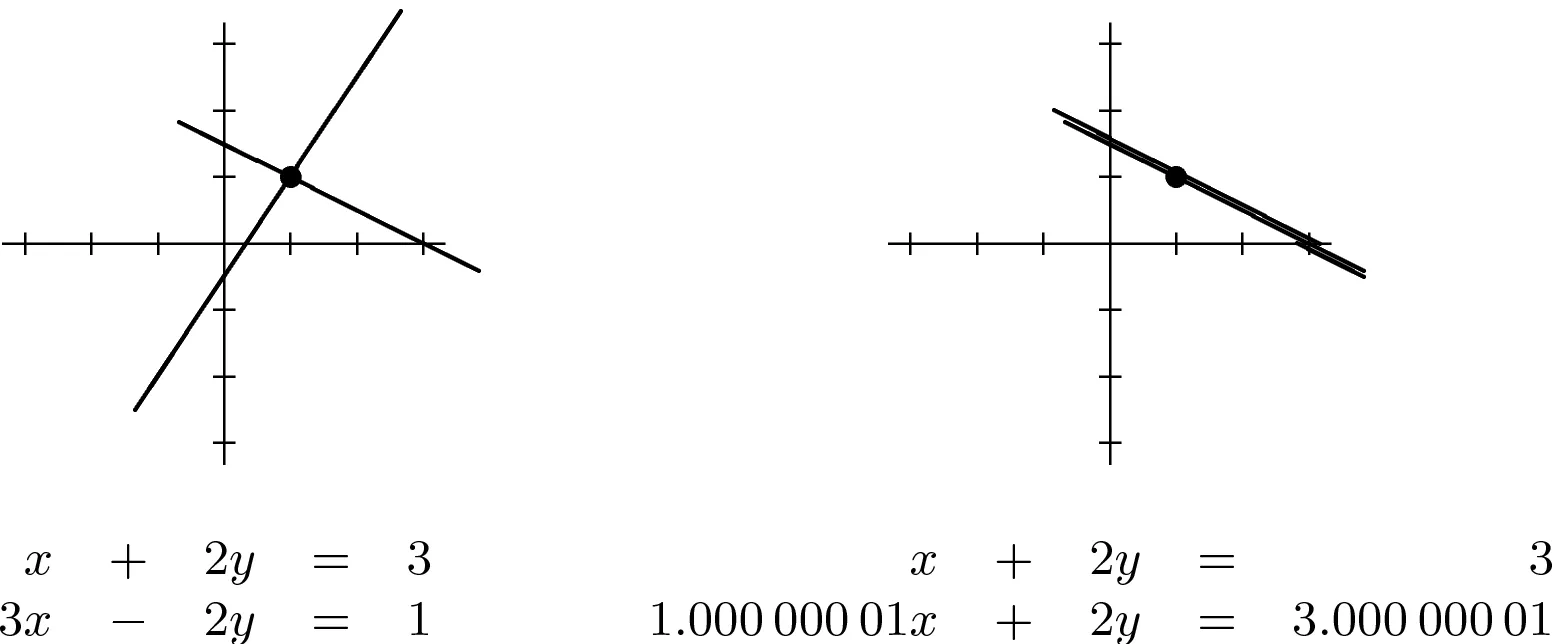
- is invertible if every output comes from exactly one input.
- Equivalent statements:
- Columns of are linearly independent.
- is full.
- The equation has a unique solution for every .
- If is not invertible (singular), multiple inputs can map to the same output, so no unique reverse exists.
- Geometric picture:
- If flattens space (for example, a plane to a line), different points collapse to the same output.
- Once points overlap after transformation, a unique reverse map is impossible.
- Quick visual test in 2D:
- Compute and (images of basis vectors).
- If they are collinear, transformed area is zero and is not invertible.
- If they are not collinear, transformed area is nonzero and is invertible.
Key Formulas
For matrix:
Quick Example
- Here, .
- The second row is a multiple of the first, so the matrix collapses 2D space onto a line.
- Therefore is singular and has no inverse.
Practical Notes
Determinant near zero implies numerical instability.
- Systems become ill-conditioned even before exact singularity.
Avoid explicit inverse when solving systems.
- Prefer stable solvers (
solve, factorisation methods).
Why This Matters for ML
- Invertibility and conditioning explain why some regression problems are numerically unstable.
- Near-singular matrices produce large parameter swings from small data perturbations.
- Regularised objectives (for example Ridge) improve conditioning by shifting spectra.
- Determinant-based terms also appear in Gaussian likelihoods and normalising transformations.