Syllabus Map
- Study map: Syllabus Study Map
Introduction
Overall Goals
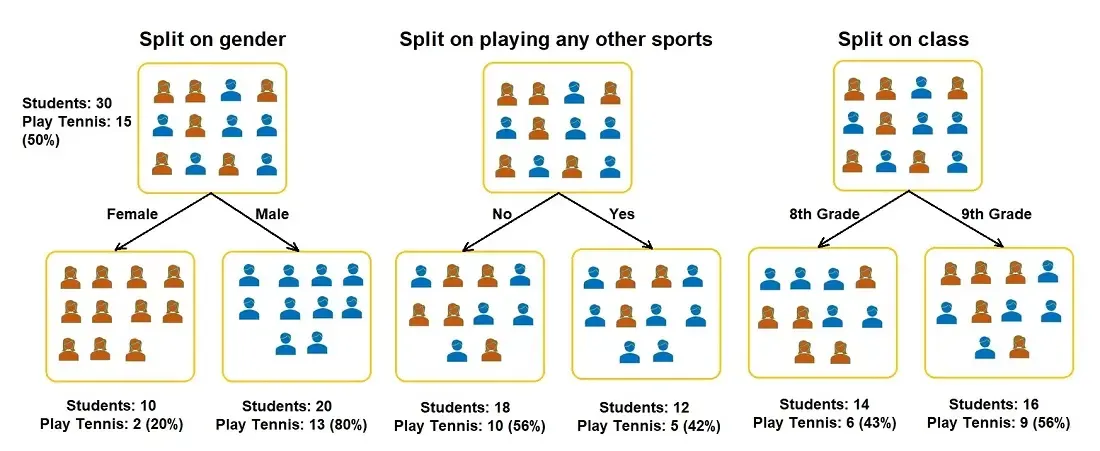
- Recursively split the dataset to improve purity
- Done until no further meaningful split is possible
Structure of a Decision Tree
Root Node
- The starting point of the decision tree and represents the entire dataset
- It is the initial node from which the tree branches out, and does not have incoming branches
Decision Node
- These nodes represent a decision point based on a feature of the data
- They have incoming and outgoing branches, as they split the data into sub-nodes
Leaf Node
- These nodes are the final nodes of the decision tree and represent the ultimate outcome
- Leaf nodes do not have any outgoing branches, as no further splitting occurs at these points
- They contain the final classification or regression value for a given data point
Parent Node
- This is a relative term, referring to any node that splits into two or more child nodes.
Child Node
- This is a relative term, referring to any node that originates from a parent node
Training Algorithm
Step-by-Step Procedure
1. Start with the full training dataset at the root node
- All samples and labels are considered together.
2. Check if the node should stop splitting
- All samples belong to one class, or
- The stopping condition is met.
For each feature
- Evaluate all possible split points.
For numeric features:
- Sort unique values.
- Compute midpoints between consecutive values.
- Each midpoint = potential threshold
For categorical features:
- Consider subsets of categories or one-hot encodings.
3. Compute the impurity or loss for each possible split
-
Use Entropy / Information Gain or Gini Index (for classification).
-
Use Mean Squared Error (for regression).
4. Select the split with the best score
-
Highest information gain or lowest impurity.
-
Record the chosen feature and threshold.
5. Partition the dataset into child nodes
-
Left node → samples satisfying the condition
-
Right node → samples not satisfying it
7. Repeat recursively for each child node
-
Treat each child as a new dataset.
-
Apply the same splitting logic.
-
Stop when leaf conditions are met.
Recursive Splitting Logic
-
The process is greedy: it chooses the best split at each step, not globally optimal.
-
The resulting tree can overfit, which is why pruning is necessary.
-
Real implementations (like CART) use binary splits only.
Splitting Criteria
Information Gain
-
Information Gain is applied to quantify which feature provides maximal information about classification based on entropy
-
The intention is decreasing the entropy initiating from the root node to the leaf nodes.
-
The information gain from splitting the set of values in a parent node is
- Where:
- is entropy before splitting,
- are the entropy of left and right subsets respectively,
- are the number of samples in the parent and child nodes respectively.
Entropy
-
The entropy of a random variable quantifies the average level of uncertainty with the variable’s potential states
-
Essentially, it is the measurement of the impurity or randomness in the data points
-
The entropy of a set is defined as
- Where:
- has the discrete states
GINI impurity
-
Calculates the probability of a feature classified incorrectly when selected randomly
-
If all the elements are linked with a single class then it can be called pure
-
The GINI impurity of a set is defined as
- Where:
- has the discrete states
Mean Squared Loss (MSE)
-
Regression-based MSE over a set
-
The Mean Squared Error of a set is defined as
Where:
- is the average value of in set
Data Splitting (CART)
| Feature Type | Split Condition | Split Decision | Example Condition |
|---|---|---|---|
| Numeric / Continuous | x < t or x > t | Sort all unique values of (x) Compute midpoints between consecutive values Each midpoint = possible threshold (t) | Age < 32.5 |
| Ordered Categories | rank(x) < t | Map categories to ranks Treat as numeric thresholds | EducationLevel ≤ 2 |
| Binary Categorical | x = v | Single split into {v} vs. {not v} | IsStudent = Yes |
| Multi-Categorical | x ∈ S or x ∉ S | Enumerate all possible subsets S of categories Often one-hot encode and treat as binary features | Colour ∈ {Red, Blue} |
| Boolean | x < 0.5 or x ≥ 0.5 | Treated as numeric with only one possible threshold | IsWeekend < 0.5 |
Stopping Condition
- Stops splitting of nodes when leaf node is reached
- Use a minimum count on the number of training instances assigned to each leaf node
- Basically atomic-class nodes
Pruning Branches
Goals of Pruning
- Prevent overfitting of model
- Reduce computational loads
- Concurrently maximising accuracy and speed
Pre-Pruning (Early Stopping)
- Maximum Depth: It limits the maximum level of depth in a decision tree
- Minimum Samples per Leaf: Set a minimum threshold for the no. of samples in each leaf node
- Minimum Samples per Split: Specify the minimal number of samples needed to break up a node
- Maximum Features: Restrict the quantity of features considered for splitting
Post-Pruning (Reducing Nodes)
- Cost-Complexity Pruning (CCP): Assigns a price to each subtree based on its accuracy and complexity, then selects the subtree with the lowest fee
- Reduced Error Pruning: Removes branches that do not significantly affect the overall accuracy
- Minimum Impurity Decrease: Prunes nodes if the decrease in impurity (Gini impurity or entropy) is beneath a certain threshold
- Minimum Leaf Size: Removes leaf nodes with fewer samples than a specified threshold
Variants of Decision Tree Algorithms
Iterative Dichotomiser 3 (ID3)
Splitting Criterion: Information Gain / Entropy.
Output: Classification ().
Feature Handling: * Works primarily with categorical features. * Does not handle continuous variables directly.
Pruning: None.
Limitation: Biased toward features with many unique values.
Base Cases
-
Applicable when deciding whether to stop the algorithm
-
Given the set of values in a parent node and unique class label to the node,
Case 1: All values of in is equal to
- Node should be represented by
Case 2: No more attributes to split the set
- Node should be represented by the most common occurrence of , or
- Node should be represented by the mean of
Recursive Case
- Given feature and threshold ,
Key Limitation
- Notice that ID3 picks a feature in feature space which provides the maximum information gain of the set .
-
However, if a feature has many distinct values splitting by that feature will produce very many small subsets.
-
Since information gain is calculated using the reduction in entropy of the set, for a very small subset :
- Since the subset is very pure, meaning that the likelihood of predicting the classes is very high.
-
The model sees feature which is used to split the node is seen as amazing since it achieves maximum information gain.
-
However, the model is actually overfitting since it is memorising the individual examples in the training dataset.
C4.5
Splitting Criterion: Gain Ratio.
Output: Classification ().
Feature Handling:
- Works with both categorical and continuous features.
Pruning: Pessimistic pruning: Replaces subtrees with leaves when the Error estimate shows no significant improvement.
Limitation: Gain Ratio can over-penalise attributes with many branches, sometimes ignoring good splits.
Gain Ratio
-
Recall the definition of entropy from above and notice how it is biased to attributes with many unique values (as mentioned in the section above)
-
C4.5 introduces Gain Ratio (GR) to normalise Information Gain by the “intrinsic information” of the split, which penalises attributes that create too many branches.
-
The “intrinsic information” of the split is calculated by the Information Split (IS), which measures how broadly the data is split by feature .
-
Given that is the distinct (for classification) or continuous (for regression) outcomes from splitting a set into subsets ,
Such that:
Pessimistic Pruning
Step 1: Grow the Full Tree
- Decision tree is grown until its maximum depth
Step 2: Estimate the True Error Rate of a Node
- The observed Error rate at a node is defined as
-
Where:
- is the number of training samples at that node
- is the number of misclassified samples
-
However, since this is measured on the training data, it likely underestimates the true Error.
-
C4.5 adjusts it upward using a pessimistic correction factor, derived from the normal approximation to the binomial distribution:
Step 3: Estimate the True Error Rate of a Sub-tree
- For any internal node in subtree , sum up the adjusted errors of its nodes:
CART
-
Splitting Criterion: Gini Impurity (for classification) or Mean Squared Error (for regression).
-
Output: Classification () and Regression ().
-
Feature Handling:
- Handles both categorical and continuous features.
- All splits are binary (i.e., each node produces exactly two child nodes).
-
Pruning: Cost-Complexity Pruning (CCP): Removes subtrees whose accuracy gain is outweighed by their complexity penalty.
-
Advantages:
- Supports both classification and regression tasks.
- Robust to noisy data.
- Naturally handles numeric thresholds.
-
Limitation:
- Always produces binary splits (even for categorical attributes with multiple levels), which may increase tree depth.
Cost-Complexity Pruning
Step 1: Grow the Full Tree
- Decision tree is grown until its maximum depth
Step 2: Calculate Cost Complexity Criterion of Tree and Subtree
- Cost complexity is the Error from collapsing the subtree at node
- The total cost complexity of a tree is defined as :
- Where:
- is the set of leaves in the entire tree,
- is the training Error of the entire tree,
- is the training Error of a single node,
- is the number of leaves in the tree
- is a tuning parameter, where a higher means more pruning and vice versa,
- is the impurity of the leaf,
- is the proportion of number of samples in node to complete tree .
Step 3: Calculate Weakest Link Pruning
- The effective cost of pruning is defined as:
- Where:
- is the increase in Error if the subtree is replaced by a leaf
- is the number of leaves removed (excluding the new leaf)
Step 4: Generate Pruning Path
-
Compute for all internal nodes
-
Prune node
-
Collapse the subtree into a leaf node
-
Repeat until only root node is left
-
This produces a sequence of nodes in order of priority:
Step 5: Select the best subtree
- Use cross-validation, validation Error, 1-standard-Error rule, etc.
- Find the optimal subtree
Bias-Variance Trade Off
Overview
- Bias causes errors due to assumptions made by the model
- Variance causes errors due to over-sensitivity to data
- Increasing variance decreases bias, and vice versa
Effect of Tree Depth
Shallow Trees
- Model cannot capture complex boundaries
- Underfitting of data
- High number of systemic errors (bias)
Deep Trees
- Model is very flexible
- Overfitting of data
- High noise sensitivity (variance)
Inference and Predictions
Classification Trees
- Given a new sample ,
- Start at the root node
- At each node, evaluate the condition
- Move to the respective branch
- Continue until a leaf node is reached
- Output the class label and probability
Regression Trees
- Given a new sample ,
- Start at the root node
- At each node, evaluate the condition
- Move to the respective branch
- Continue until a leaf node is reached
- Output the numeric value
Decision Trees In Practice
When to Use Decision Trees
- When you need rule-based decisions that are easy to audit or deploy.
- When feature interactions are important and hard to encode manually.
- When you want a fast, non-parametric baseline without heavy preprocessing.
- When you need quick feature importance from split statistics.
When Not to Use Decision Trees
- When you need smooth, continuous predictions for regression tasks.
- When data is high-dimensional and sparse with many rare categories.
- When probability calibration is critical without post-processing.
- When strict monotonic or constrained relationships are required.
Practical Notes
Regularization
- Control depth and minimum leaf sizes to manage variance.
- Use cross-validation to pick pruning or depth settings.
Data Imbalance and Generalization
- Handle class imbalance with class weights or balanced sampling.
- Prune for generalisation, not just training accuracy.